
Wine Guardian D025: Ultimate Climate Control Guide
Expert guide to the Wine Guardian D025 cooling unit. Learn specifications, installation tips, and how to protect your wine collection perfectly.
Protecting a valuable wine collection requires more than beautiful racking and elegant design. The foundation of any successful wine cellar is precise climate control, and choosing the right cooling system makes the difference between a showpiece that preserves your investment and one that disappoints. For small to medium residential cellars and boutique commercial applications, the wine guardian d025 has earned its reputation as a reliable, ducted solution that delivers professional-grade performance without unnecessary complexity. Whether you're planning a compact urban wine room or expanding a traditional cellar, understanding this cooling unit's capabilities helps ensure your collection ages gracefully for decades.
Understanding the Wine Guardian D025 Specifications
The wine guardian d025 is engineered specifically for wine cellars up to 265 cubic feet, making it ideal for residential spaces that house between 500 and 1,000 bottles depending on racking configuration. This compact powerhouse operates on standard 115V/60Hz electrical service, eliminating the need for special electrical upgrades in most homes.
Key Technical Specifications:
Cooling capacity: 2,500 BTU/hour
Voltage: 115V/60Hz, single phase
Maximum cellar volume: 265 cubic feet
Operating temperature range: 50°F to 65°F
Humidity management: 50% to 70% RH
Refrigerant: R410A (environmentally conscious)
Sound level: 45-48 dB (comparable to a quiet conversation)
The detailed specifications and features of the D025 demonstrate why this unit remains a preferred choice for designers and homeowners who demand precision. Unlike larger commercial units, the D025 fits within standard wall cavities or mechanical closets without consuming valuable cellar square footage.
Ducted Configuration Advantages
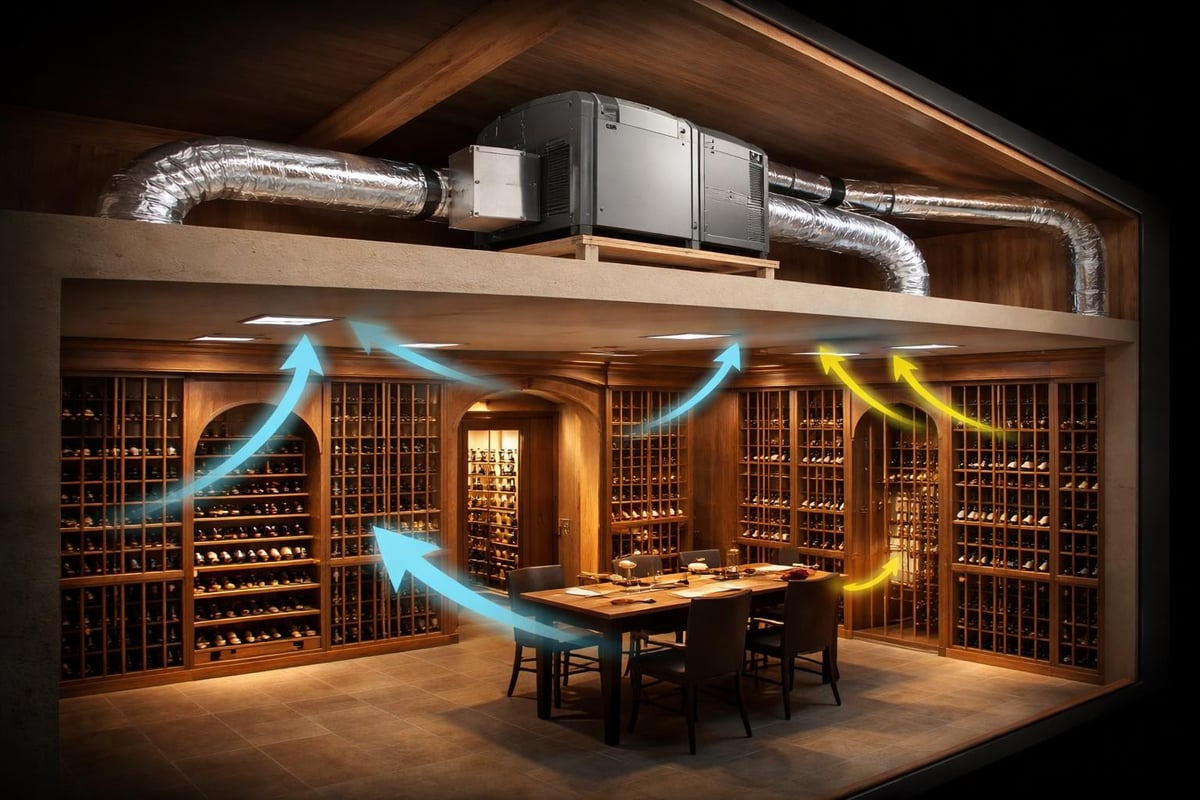
What distinguishes the wine guardian d025 from through-wall alternatives is its fully ducted design. This configuration allows the unit to be installed remotely from the cellar itself, typically in an adjacent closet, attic space, or mechanical room. The benefits extend beyond aesthetics.
Remote installation means:
Noise reduction - Mechanical sounds remain outside the cellar environment
Design flexibility - No visible equipment interrupts your cellar's visual appeal
Heat management - Exhaust heat dissipates away from living spaces
Maintenance access - Service technicians don't need to enter the cellar
For custom wine cellar designs that prioritize both function and beauty, ducted systems preserve the architectural integrity of glass walls, traditional millwork, and modern metal racking installations.
Installation Requirements and Best Practices
Professional installation of the wine guardian d025 requires careful planning during the design phase. The comprehensive installation and operation manual provides detailed technical guidance, but several critical considerations determine long-term performance.
Ductwork Design Essentials
Proper ductwork represents the circulatory system of your cellar's climate control. Undersized ducts restrict airflow, forcing the unit to work harder and potentially fail prematurely. Oversized ducts reduce air velocity, creating dead spots where temperature and humidity vary.
Duct Component | Recommended Size | Material | Purpose |
|---|---|---|---|
Supply duct | 6" diameter | Insulated flexible or rigid | Delivers cooled air |
Return duct | 8" diameter | Insulated flexible or rigid | Extracts warm air |
Supply register | 6" x 6" minimum | Metal, paintable | Air distribution |
Return grille | 8" x 8" minimum | Metal, paintable | Air collection |
The supply duct should distribute cool air near the ceiling where warm air naturally accumulates, while the return grille pulls air from the lower portion of the cellar. This creates optimal circulation patterns that prevent stratification and maintain consistent conditions throughout the space.
Electrical and Drainage Considerations
The wine guardian d025 requires a dedicated 15-amp circuit protected by a GFCI breaker. While this seems straightforward, placement of the electrical outlet matters considerably. Position it within six feet of the planned unit location to avoid extension cords, which violate most building codes and void manufacturer warranties.
Condensate management often gets overlooked during planning. The unit produces moisture during operation that must drain properly. Options include:
Gravity drain to nearby floor drain or exterior
Condensate pump for uphill drainage
Drip pan with float switch for emergency backup
In Texas locations where homes may lack basement floor drains, condensate pumps become necessary. Quality pumps add minimal cost but prevent water damage from overflow situations.
Temperature and Humidity Management
The wine guardian d025 excels at maintaining the precise conditions that allow wine to mature properly. Most collectors understand temperature matters, but humidity control proves equally critical for long-term storage success.
Optimal Storage Parameters
Red wines, white wines, and sparkling wines all benefit from storage between 55°F and 58°F. This narrow range slows chemical reactions just enough to allow complex flavors to develop without accelerating aging. The D025 maintains temperature within ±2°F once properly calibrated, providing the consistency serious collectors demand.
Humidity presents a more nuanced challenge. Too low, and corks dry out, allowing oxygen infiltration that ruins wine. Too high, and labels deteriorate while mold threatens collections. The ideal range sits between 60% and 70% relative humidity.
The integrated humidifier compatible with the D025 addresses this concern directly. This factory-engineered accessory integrates seamlessly with the cooling unit, automatically adding moisture when levels drop below the setpoint. For cellars in dry climates or homes with aggressive whole-house dehumidification, this upgrade proves essential.

Seasonal Considerations in Texas
Texas presents unique climate challenges that impact wine cellar performance. Summer temperatures exceeding 100°F and winter humidity swings test cooling equipment year-round. The wine guardian d025 handles these extremes when properly supported by adequate insulation and vapor barriers.
Critical construction elements include:
R-19 minimum wall insulation (R-30 preferred)
R-38 ceiling insulation if attic space above
Insulated, weatherstripped exterior-grade door
Sealed electrical penetrations and ductwork
Turnkey wine cellar design-build services ensure these envelope requirements get addressed before equipment selection, preventing undersized units or constant cycling that shortens lifespan.
Maintenance and Longevity
Professional-grade climate control equipment demands professional-grade maintenance. The wine guardian d025 includes several user-serviceable components, but comprehensive annual inspections by qualified technicians extend operational life significantly.
Routine Maintenance Tasks
6 montha filter changes represent the single most important maintenance task owners can perform. The D025 uses standard 16" x 20" x 1" filters available at any hardware store. Dirty filters restrict airflow, reducing efficiency and forcing components to work harder.
Simple monthly checklist:
Power down the unit at the breaker
Remove and inspect air filter
Replace if visibly dirty or every 30 days
Vacuum return grille and supply registers
Verify condensate drain flows freely
Restore power and confirm normal operation
This five-minute routine prevents 80% of service calls and protects your investment in both the equipment and the wine it preserves.
Professional Service Requirements
Annual professional maintenance addresses components beyond typical owner capabilities. Certified technicians inspect refrigerant levels, electrical connections, compressor operation, and control calibration. They also clean evaporator and condenser coils, which accumulate dust that reduces heat transfer efficiency.
Service Item | Frequency | Typical Cost | Impact if Neglected |
|---|---|---|---|
Filter replacement | Monthly | $5-10 | Reduced airflow, inefficiency |
Coil cleaning | Bi Annually | $150-200 | 30% efficiency loss |
Refrigerant check | Bi Annually | Included | Gradual cooling failure |
Control calibration | Bi Annually | Included | Temperature fluctuations |
Drain line flush | Bi Annually | Included | Water damage risk |
Professional wine cellar maintenance services often bundle equipment service with cellar inspections, ensuring racking, lighting, and finishes receive attention alongside climate systems.
Integration with Cellar Design Styles
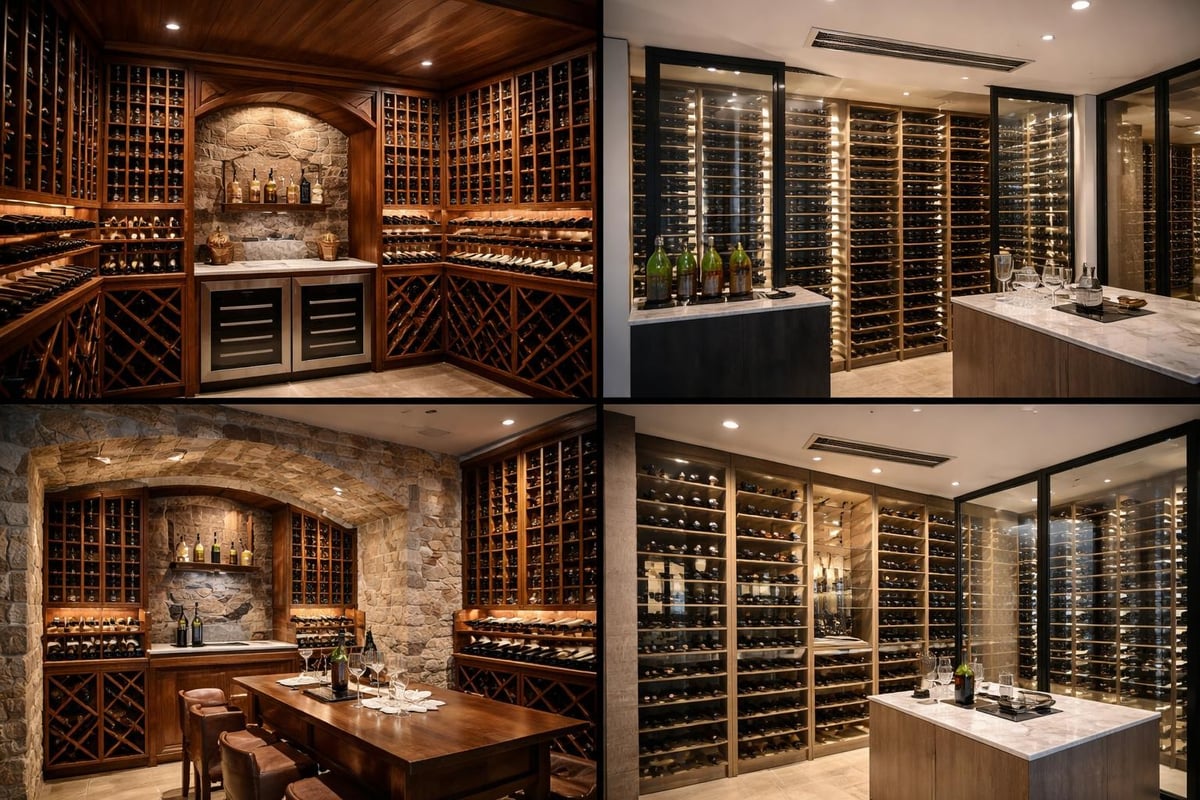
The wine guardian d025's ducted configuration makes it compatible with virtually any aesthetic approach to wine cellar design. From rustic estate wine cellars featuring reclaimed timber to modern minimalist installations with floating metal racks, this unit disappears from view while providing essential climate control.
Glass Showcase Applications
Glass-enclosed showpiece wine cellars demand invisible mechanical systems. Wall-mounted or through-wall units interrupt sightlines and detract from the floating effect these designs achieve. The D025's remote installation allows floor-to-ceiling glass on all visible walls while maintaining museum-quality environmental control.
The key consideration involves ductwork routing. Supply and return ducts typically penetrate through the ceiling or a single solid wall, with registers positioned to avoid blocking wine displays. Powder-coated metal registers can match racking finishes, virtually disappearing against dark backgrounds.
Traditional and Transitional Styles
Traditional wine cellars with classic wood construction benefit equally from ducted cooling. Ornate crown molding and detailed millwork accommodate tastefully sized grilles that complement rather than compete with the architecture. Bronze, brass, or oil-rubbed finishes integrate seamlessly with hardware and lighting selections.
Transitional designs that blend contemporary and traditional elements appreciate the D025's flexibility. These spaces might feature clean-lined metal racking alongside warmth from natural wood tones, creating sophisticated environments where visible equipment would feel jarring.
Sizing Accuracy and Heat Load Calculations
Selecting the wine guardian d025 requires accurate heat load calculations that account for every source of thermal gain. Oversized units cycle too frequently, creating temperature swings and humidity issues. Undersized units run continuously, failing to maintain setpoints during peak demand.
Critical Heat Load Factors
The heat load calculator considers variables beyond simple cubic footage. Wall area, insulation values, ceiling height, lighting wattage, door openings, and adjacent space temperatures all contribute to the thermal equation.
Primary heat sources in wine cellars:
Walls adjacent to unconditioned spaces
Ceilings below attics or second floors
Glass walls or doors (even insulated)
Lighting fixtures (especially incandescent)
Door openings and infiltration
People occupancy during events
A 200-cubic-foot cellar with one glass wall and recessed lighting might generate the same heat load as a 265-cubic-foot fully enclosed space with LED lighting. Accurate calculations prevent equipment mismatches that compromise performance.
When the D025 Fits Perfectly
This unit serves compact urban wine cellars exceptionally well, where space constraints demand efficient equipment that performs reliably without oversized mechanical installations. Condominiums, townhomes, and smaller single-family residences with 500 to 800-bottle collections represent the sweet spot.
Commercial applications include boutique hotel wine displays, private dining rooms in upscale restaurants, and executive office wine amenities. These spaces prioritize aesthetics and quiet operation, where the D025's ducted design and moderate sound levels excel.
Accessories and Customization Options
Beyond the base wine guardian d025 unit, several accessories optimize performance for specific applications. Understanding these options during the planning phase prevents expensive retrofits later.
Humidity Enhancement Systems
The factory integrated humidifier mounts directly to the cooling unit, sharing the same water source as the condensate drain. This elegant solution requires no additional plumbing and activates automatically based on humidity sensor readings.
Alternative standalone humidifiers work but require separate installation, water sources, and control systems. The integrated approach simplifies maintenance and ensures coordinated operation between cooling and humidification cycles.
Ductwork Accessories
The duct collar system provides professional connections between the unit and ductwork, preventing air leaks that reduce efficiency. These collars create airtight seals while accommodating both rigid and flexible duct materials.
Insulated flexible ductwork proves popular for residential installations where routing around framing members and mechanical systems becomes necessary. Rigid ductwork delivers superior performance where straight runs allow, particularly for commercial projects with dedicated mechanical spaces.
Real-World Performance in Texas Projects
Projects completed across Texas demonstrate the wine guardian d025's versatility. A Memorial Villages installation transformed a former powder room into a 600-bottle showcase with frameless glass walls, where the D025 installed in an adjacent closet maintains perfect conditions invisibly.
In Highland Park, a traditional mahogany cellar beneath a grand staircase relies on the same unit to handle the thermal load from a crystal chandelier and frequent entertaining access. The ducted configuration keeps mechanical noise away from the home's formal entertaining spaces.
Performance metrics from installed projects:
Temperature variance: ±1.5°F over 24-hour periods
Humidity stability: ±5% RH throughout seasons
Average runtime: 40-50% during Texas summers
Service interval: 12-month preventive maintenance
Equipment lifespan: 12-15 years with proper care
These results demonstrate that proper equipment selection, professional installation, and routine maintenance deliver decades of reliable service protecting valuable collections.
Planning Your Climate Control Investment
The wine guardian d025 represents a significant component of overall cellar construction costs, typically accounting for 15-20% of total project budgets. However, this investment protects wine collections worth many times the cellar's construction cost.
Budget Expectations
Equipment and installation cost breakdown:
Component | Cost Range | Notes |
|---|---|---|
D025 unit | $2,800-3,200 | Varies by supplier, warranty |
Ductwork materials | $300-600 | Depends on run length, type |
Electrical work | $400-800 | Dedicated circuit, outlet |
Installation labor | $800-1,200 | Professional HVAC contractor |
Humidifier upgrade | $400-600 | Factory integrated option |
Total system | $4,700-6,400 | Complete installed cost |
These figures represent quality installations using licensed contractors and premium materials. Budget options exist but often create long-term reliability concerns that cost more to remedy than initial savings provide.
Return on Investment Considerations
A properly climate-controlled cellar protects wine investments while adding tangible value to luxury homes. Appraisers recognize professional installations as significant amenities, particularly in markets like River Oaks, Westlake, and Preston Hollow where discerning buyers expect exceptional wine storage.
Beyond property value, the wine guardian d025 prevents collection losses from temperature fluctuations or humidity extremes. A single case of damaged first-growth Bordeaux or cult California Cabernet exceeds the cost of proper climate control many times over.
Comparing Legacy and Current Models
Wine Guardian's legacy D025 model served the industry for years before the current generation introduced refinements based on field experience. Understanding these differences helps when evaluating equipment for new installations versus maintaining existing systems.
Current generation improvements include enhanced control algorithms that reduce temperature swings, quieter compressor operation, and improved energy efficiency meeting modern standards. The refrigerant change to R410A reflects environmental responsibility while maintaining cooling capacity.
Owners of legacy units benefit from continued parts availability and service support, though eventual replacement with current technology makes sense during major renovations or when repair costs approach replacement economics.
The wine guardian d025 delivers professional-grade climate control in a compact, ducted package ideally suited to residential and boutique commercial applications. When properly sized, installed, and maintained, this reliable unit protects valuable collections for decades while remaining invisible within beautifully designed spaces. Whether you're planning an intimate wine room or a substantial collector's cellar, Prestige Wine Cellars brings the expertise to integrate climate control seamlessly with architectural vision, creating timeless environments where your collection matures perfectly.
Your Dream Wine Cellar Starts Here
Let our design team craft a cellar that matches your taste, space, and your collection — built for beauty, function, and prestige.

Email us at
Serving Austin, Dallas–Fort Worth, Houston & San Antonio