
Compact
High-efficiency engineering meets refined design—bringing luxury wine storage to smaller spaces without compromise.
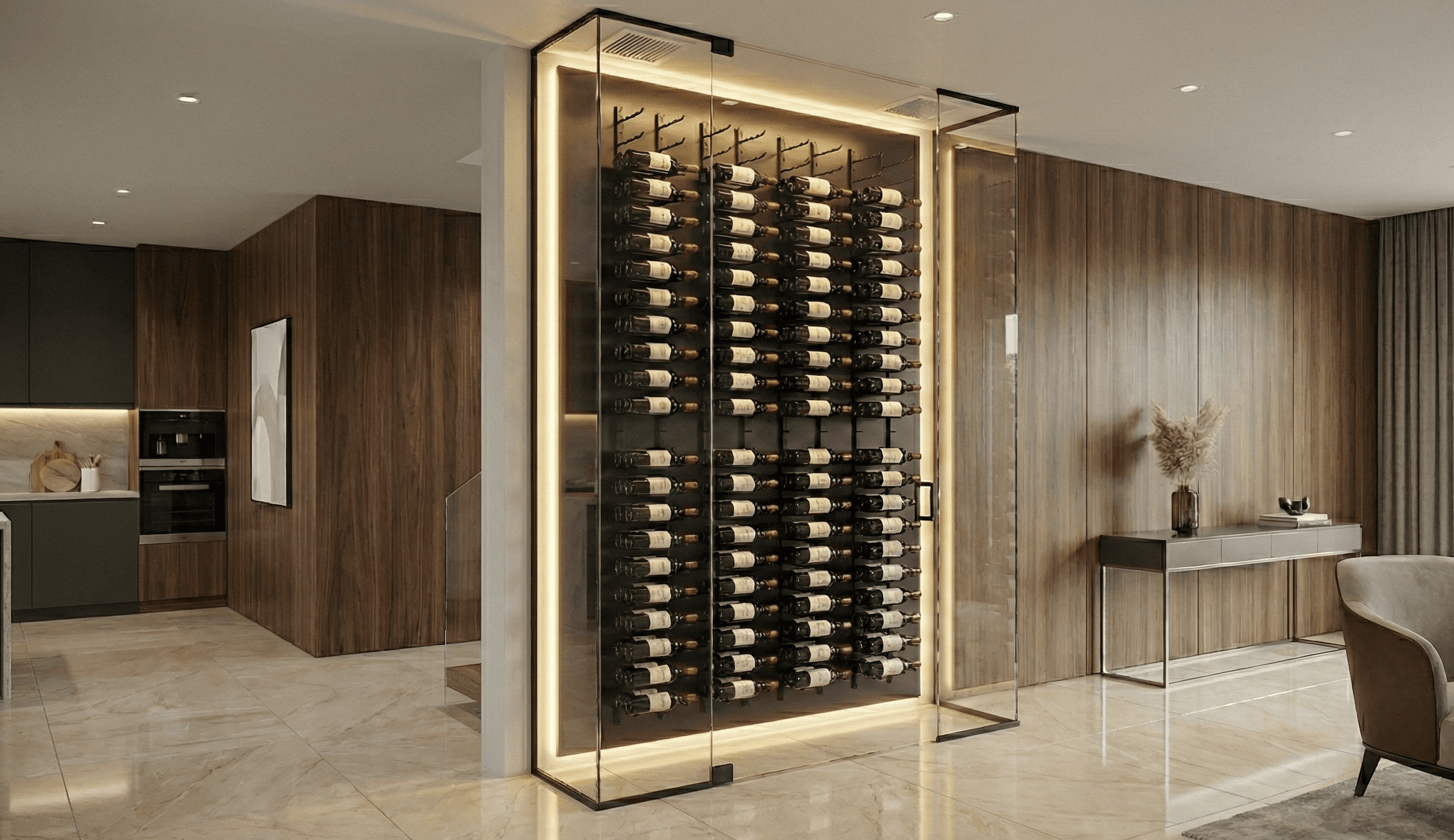
Design a Compact Wine Cellar That Makes Every Inch Count
Small space. Serious storage. Refined design. Our team creates custom, climate-controlled compact wine cellars for closets, under-stair spaces, niches, kitchens, dining rooms, and luxury homes across Austin, Dallas, Houston, and the Texas Hill Country. Every design is tailored to your collection, bottle capacity, home architecture, and long-term storage needs.
As urban living expands and home footprints become more efficient, Compact Urban wine cellars have emerged as one of the fastest-growing cellar categories. Ranked #5 in the 2026 Wine Cellar Styles Guide , this style is driven by rising metropolitan density, increased demand for smart space utilization, and the desire for luxury amenities within tighter square footage.
Compact Urban wine cellars deliver full climate-controlled preservation in spaces once considered too small for a cellar—under staircases, hallways, closets, kitchen niches, or narrow alcoves. Through intelligent engineering, vertical racking, modular systems, and creative architectural integration, these cellars prove that world-class wine storage can exist anywhere.
1. High-Density Vertical Storage Systems
The 2026 report highlights that urbanization is driving the need for vertical racking solutions that maximize bottle count in minimal footprints .
Vertical systems often include:
tall label-forward metal racks
stacked acrylic or steel supports
narrow-profile peg walls
floor-to-ceiling steel rods
This approach maximizes capacity even when floor space is limited.
2. Intelligent Space Repurposing
Compact Urban cellars thrive in unconventional locations:
under-stair enclosures
converted coat closets
hallway recessed wine displays
narrow alcoves
pantry conversions
between-stud wine walls
inset shelving carved from unused cavities
Designers are increasingly utilizing “found space” to introduce climate-controlled wine storage without sacrificing functional living areas.
3. Frameless Glass Enclosures
To avoid making small spaces feel even smaller, compact wine rooms often use:
frameless glass doors
minimalist black metal supports
full-glass cubes integrated into cabinetry
This maintains visual openness while still delivering a controlled environment.
4. Modular or Multi-Functional Racking
Compact cellars frequently integrate modular components so the layout can adapt as the collection grows.
Common features:
adjustable shelf heights
removable case storage
multi-depth wall racks
modular stacking systems
5. Integrated LED Lighting
Lighting is essential in small spaces.
Designers rely on:
soft linear LEDs
hidden light channels
warm accent lighting behind racks
low-heat illumination to avoid climate disruption
The result: a high-impact showcase that feels much larger than its footprint.
1. Luxury Wine Storage Without Needing a Full Room
This style brings the full capabilities of a traditional cellar to areas as small as 15–30 square feet.
2. Perfect for Urban Homes, Condos, and Modern Renovations
Compact Urban designs allow high-value wine storage even in:
downtown condos
townhomes
metropolitan apartments
new construction with smaller utility spaces
3. Cost-Efficient & Space-Efficient
Compact designs often involve less construction material and can be more affordable while still offering premium features.
4. Extremely High Visual Impact
A small, beautifully lit wine display can dramatically elevate the aesthetic of an entryway, kitchen, or living room.
5. Highly Customizable
Compact wine rooms allow homeowners to tailor storage to their exact bottle count and aesthetic.
1. Under-Stair Wine Cellar
The most popular configuration by far.
Elegant glass panels and tall racking systems transform unused space into an architectural feature.
2. Closet Conversion Wine Cellar
A small closet becomes a fully climate-controlled cellar with floor-to-ceiling racking and a glass door.
3. Wine Wall / Vertical Wall Display
Ideal for homes lacking depth.
The entire collection is displayed on a thin wall-mounted racking system.
4. Pantry or Niche Wine Room
Integrated into cabinetry or recessed into kitchen architecture for convenient access.
5. Micro Wine Rooms (<50 sq. ft.)
For serious collectors in urban environments, even the smallest rooms can be transformed into efficient cellars.
Racking Materials
black steel
stainless steel rods
acrylic shelves
modular metal peg systems
narrow wood cubbies
Finishes
matte black
warm oak
light neutral tones
concrete or smooth-wall textures
Lighting
integrated LED strips
ceiling spotlights
backlit shelving
perimeter lighting
Lighting is intentionally layered to create depth and expand the perceived space.
1. Climate-Controlled System Sizing
Compact enclosures require precise engineering because small spaces heat up faster.
Cooling units must be properly sized for the limited volume and possible glass exposure.
2. Ventilation and Sound Management
Urban and compact installations often need:
quieter cooling systems in nearby living spaces
ducted or split systems for silence
concealed mechanical placement
3. Insulation & Vapor Barrier
Regardless of size, every wine cellar must include:
vapor barrier
rigid foam insulation
sealed framing
proper door seals
This is non-negotiable for proper preservation.
4. Glass Engineering (Optional but Common)
For under-stair and wall-mounted displays:
Low-E glass
insulated double-pane glass
airtight framing
compact pivot or swing doors
5. LED Heat Management
With limited air volume, only low-heat LEDs should be used to avoid temperature spikes.
This style is ideal for:
metropolitan luxury condos
downtown apartments
high-rise residences
modern townhomes
smaller suburban homes
open-concept remodels needing a focal point
It’s also perfect for homeowners who value design impact without requiring hundreds of bottles.
FAQ: Compact Urban Wine Cellars
How many bottles can a compact cellar store?
Anywhere from 80 to 500+, depending on racking density and vertical storage.
Can I turn any closet into a wine cellar?
Yes — as long as it can be properly insulated and cooled.
Do compact cellars cost less?
Often yes, but glass and climate engineering can elevate the investment.
Does a small cellar still need a cooling unit?
Yes — wine-specific climate control is required no matter the size.

Email us at
Give us a call
Serving Austin, Dallas–Fort Worth, Houston & San Antonio