
Learn how custom wine cellars are planned, engineered, and built through in-depth articles, educational videos, and clear answers to the questions clients ask us most.


Videos
Watch Wine Cellars Come to Life
Explore videos showcasing custom wine cellar design, engineering, and craftsmanship—from modern glass wine cellars to timeless wood wine cellars built for beauty and long-term preservation.
For complete access to all of our custom wine cellar education video guides, click the link below.

How Wine Cellars Work
A properly built wine cellar coasts through a power outage instead of spiking. Stone, tile, dense insulation and a fully sealed envelope give the room thermal mass, so it holds its temperature and releases it slowly. The wine itself warms far slower than air, so it barely moves for hours. Serious collections can add a second system on a backup generator.

How Wine Cellars Work
Yes. We embed smart thermo-hygrometer probes in the racking, connected to Wi-Fi and your phone, tracking temperature and relative humidity in real time. If the room drifts about three degrees off 55°F, humidity leaves the 50–70% range, or the door is left cracked, you get an instant push notification, so a problem is fixed in minutes.

Wine Cellar Design
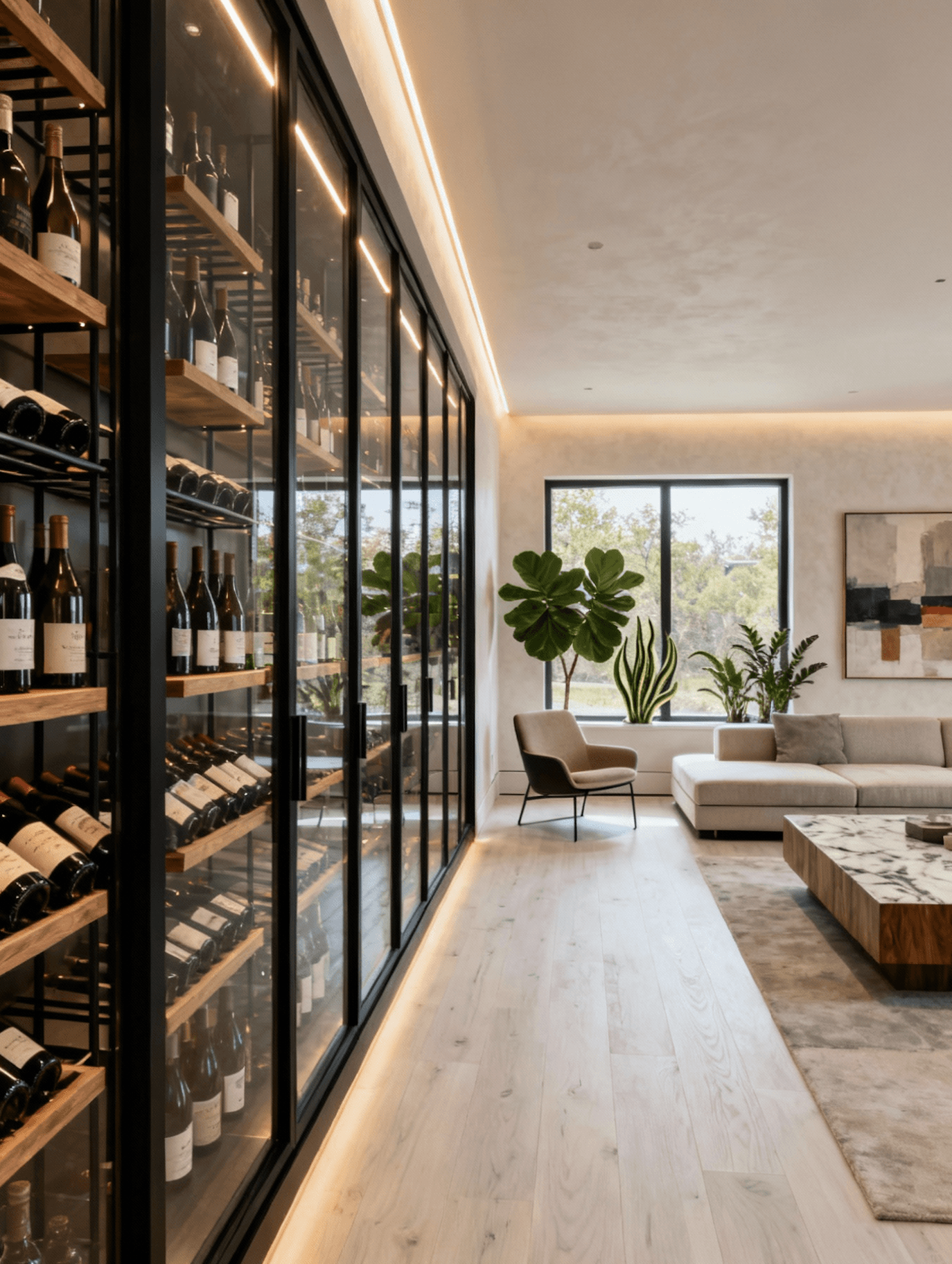
Yes. You don't need a walk-in room. With about 18 inches of depth, a modern glass display wine wall can be built directly into an existing wall, with bottles stored horizontally, hidden LED lighting and one clean plane of glass. Because it's a shallow cavity, it needs its own sealed envelope and a small, properly sized cooling feed to hold 55°F.
FAQ
How much does a custom wine cellar cost?
Every cellar is priced from its size, racking, glass, and cooling requirements. Projects start around $50,000, and the average is about $80,000, while large walk-in cellars with full climate control can reach six figures. The biggest cost drivers are the cooling system, glass area, and racking material. We provide a complimentary consultation and design concept within 5 business days.
What temperature and humidity should a wine cellar be?
The target is 55°F with 50-70 percent relative humidity. Stable conditions matter more than exact numbers — swings in temperature and humidity are what damage wine, dry corks, and spoil labels. That is why a properly sized cooling system and a sealed envelope are the heart of every build.
Which wine cellar cooling system do I need?
There are three families: self-contained (through-wall), split systems, and ducted systems. The right choice comes from a load calculation — room volume, insulation, glass area, and where the heat exhausts — not a catalogue. In hot climates like Texas, undersizing is the most common and most expensive mistake.
Ready to Start Your Own Cellar?
Tell us about your space and your collection, and we’ll start your design.

Email us at
Serving Austin, Dallas–Fort Worth, Houston & San Antonio