
Cable Wine Displays: Modern Storage Engineering
Discover how cable wine displays blend precision engineering with elegant design. Expert insights on installation, materials, and customization.
The evolution of wine storage has brought us to a remarkable intersection of engineering and aesthetics. Cable wine displays represent one of the most sophisticated approaches to showcasing premium collections, combining minimalist design principles with structural precision. These systems suspend wine bottles using precision-engineered cables and mounting hardware, creating the illusion that bottles float within the space while maintaining absolute stability and security. For discerning collectors, restaurateurs, and designers seeking to transform wine storage into architectural art, understanding the technical excellence and design versatility of these systems opens new possibilities for cellar design.
The Engineering Foundation of Cable Display Systems
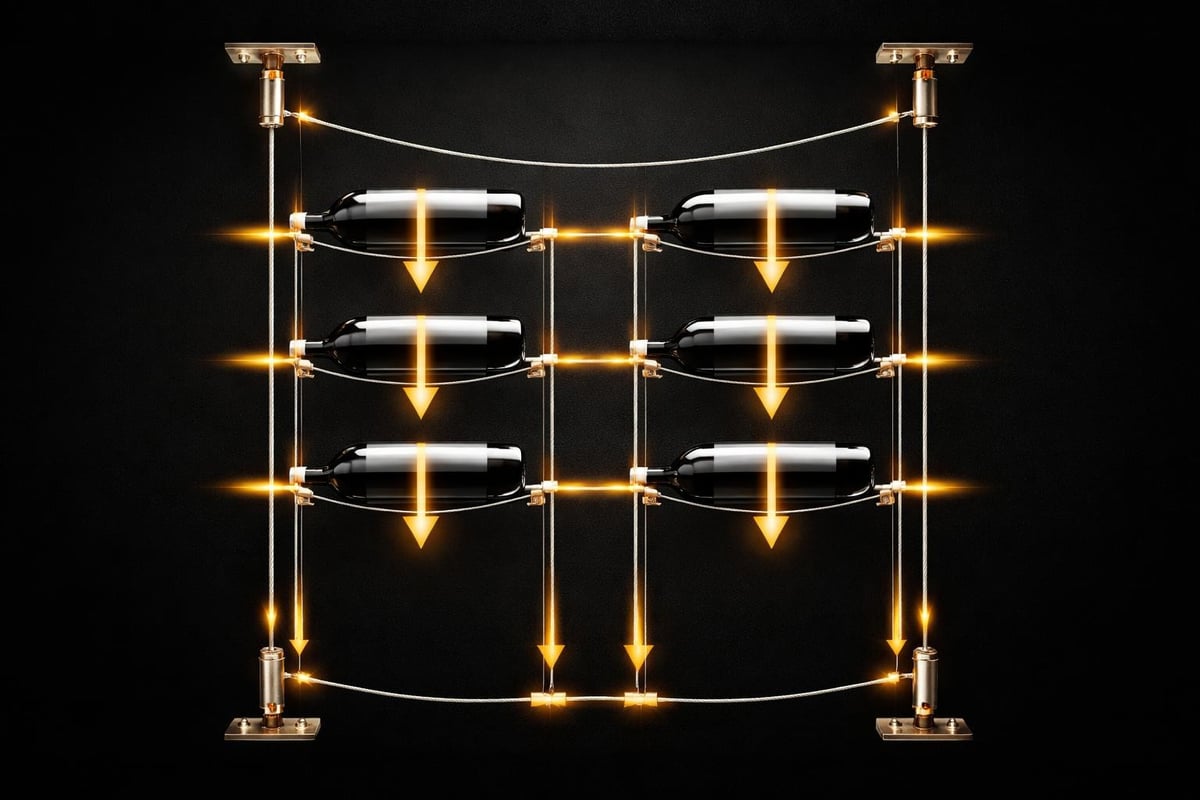
Cable wine displays operate on deceptively simple principles that require extraordinary precision in execution. Each system relies on vertically tensioned stainless steel cables that run from floor to ceiling or ceiling to countertop, creating a rigid framework capable of supporting significant weight loads.
The structural integrity depends on proper cable tensioning and anchor point selection. Pre-stretched cables eliminate the gradual stretching that occurs with standard cable systems, ensuring your display maintains perfect alignment for decades. The mounting hardware must distribute weight evenly across attachment points, typically requiring structural reinforcement in walls or ceilings to handle the cumulative load of a fully stocked display.
Material Selection and Performance Standards
Choosing the right materials separates exceptional installations from merely adequate ones. Premium cable wine displays utilize Type 316 stainless steel cables that resist corrosion even in climate-controlled environments where humidity levels fluctuate. The cable diameter typically ranges from 1/8 inch to 3/16 inch, calibrated to support specific weight capacities while maintaining visual delicacy.
Component | Standard Material | Premium Alternative | Key Benefit |
|---|---|---|---|
Cables | 304 Stainless Steel | 316 Marine-Grade Steel | Superior corrosion resistance |
Mounting Hardware | Zinc-Plated Steel | Brass or Stainless | Longevity and finish consistency |
Cradle Shelves | Powder-Coated Aluminum | Solid Brass or Acrylic | Weight capacity and aesthetics |
Tensioners | Standard Threaded | Precision Turnbuckles | Fine-tuned adjustment capability |
The technical specifications and compliance requirements ensure these systems meet both functional demands and safety standards that protect your investment.
Design Flexibility and Customization Options
One of the most compelling advantages of cable wine displays lies in their exceptional adaptability to diverse architectural contexts. These systems integrate seamlessly into spaces ranging from intimate residential cellars to expansive commercial installations.
The modular nature allows for precise capacity customization. You can configure displays to hold anywhere from 50 bottles in a compact urban setting to several thousand bottles in resort or estate applications. Each cradle position can accommodate standard 750ml bottles, magnums, or even specialty formats through custom bracket design.
Finish Options and Aesthetic Integration
Contemporary cable systems offer finish versatility that complements any design vocabulary:
Satin stainless steel provides timeless modern elegance
Powder-coated black creates dramatic contrast in minimalist spaces
Brushed brass or bronze adds warmth to traditional environments
Custom color matching ensures cohesion with existing millwork
The design flexibility and integration capabilities allow these systems to adapt to virtually any architectural vision while maintaining structural performance.
When planning your custom wine cellar design, cable displays offer unique advantages in tight urban spaces or areas with challenging structural limitations. The minimal footprint maximizes bottle capacity per square foot while creating sightlines that make spaces feel larger and more open.
Installation Considerations and Technical Requirements
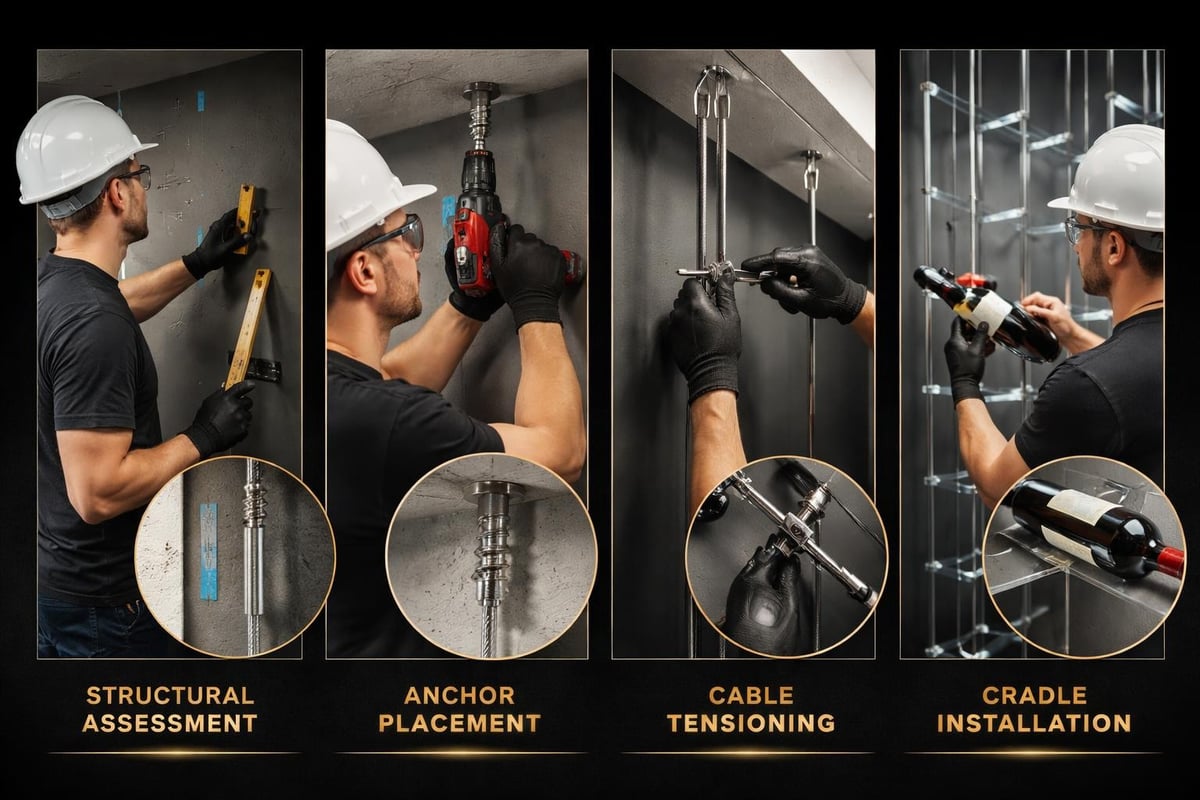
Successful cable wine display installation demands meticulous planning and execution. The process begins long before cables are tensioned, starting with comprehensive structural analysis.
Critical pre-installation steps include:
Structural assessment to identify load-bearing points and required reinforcement
Climate control verification ensuring consistent temperature and humidity
Precise measurement and layout with tolerances within 1/16 inch
Anchor point reinforcement using backing plates or structural blocking
Cable pre-stretching to eliminate future adjustment needs
The installation timeline varies based on display size and complexity. A residential installation of 200-300 bottles typically requires 3-5 days of on-site work, while commercial projects spanning thousands of bottles may extend to several weeks.
Ceiling and Wall Mounting Specifications
The cable-suspended shelving systems require different mounting approaches depending on your architectural structure. Concrete ceilings provide ideal anchor points, accepting expansion bolts that distribute loads safely across the structure. Wood-framed ceilings necessitate locating joists or installing cross-blocking to create adequate load paths.
Wall-mounted systems demand equal rigor. The vertical cables must attach to solid backing, never just drywall or decorative finishes. For glass-enclosed wine rooms, specialized mounting brackets accommodate the unique challenges of securing cables while maintaining the transparency that makes these spaces so visually compelling.
Space Planning and Capacity Optimization
Strategic space planning transforms cable wine displays from simple storage into curated showcases. The spacing between cables directly impacts both capacity and visual rhythm.
Standard configurations place cables on 12-inch centers, allowing comfortable bottle retrieval while maximizing density. Luxury installations often expand spacing to 15 or 18 inches, creating breathing room that elevates individual bottles into objets d'art. This approach suits collectors focusing on rare vintages or bottles with distinctive shapes deserving individual appreciation.
Bottle Capacity Calculations
Understanding capacity helps align your display with collection growth projections:
Display Height | Cable Spacing | Estimated Capacity |
|---|---|---|
8 feet | 12 inches | 60-80 bottles per linear foot |
10 feet | 12 inches | 75-100 bottles per linear foot |
8 feet | 15 inches | 48-64 bottles per linear foot |
10 feet | 18 inches | 40-55 bottles per linear foot |
The floating cable wine rack designs excel in restaurant applications where visibility and accessibility must balance with capacity demands.
Vertical spacing between cradle shelves typically ranges from 4 to 6 inches depending on bottle formats. Mixed-format displays benefit from adjustable cradle systems that accommodate both standard bottles and larger formats on the same cable runs.
Commercial Applications and Design Trends
Cable wine displays have become the preferred solution for high-end hospitality environments seeking to showcase wine programs as experiential elements. The transparency and architectural presence transform wine from commodity to conversation piece.
Leading applications include:
Steakhouse feature walls visible from dining areas
Hotel lobby installations creating arrival moments
Resort wine bars emphasizing curation and quality
Private club displays communicating exclusivity
Retail environments merging storage with merchandising
The modern wine storage preferences reflect broader design movements toward material honesty, structural expression, and spatial transparency. Cable systems align perfectly with these values, making the engineering itself part of the aesthetic appeal.
Our glass-enclosed showpiece wine cellars frequently incorporate cable displays as central elements, combining climate-controlled precision with museum-quality presentation.
Integration With Climate Control Systems
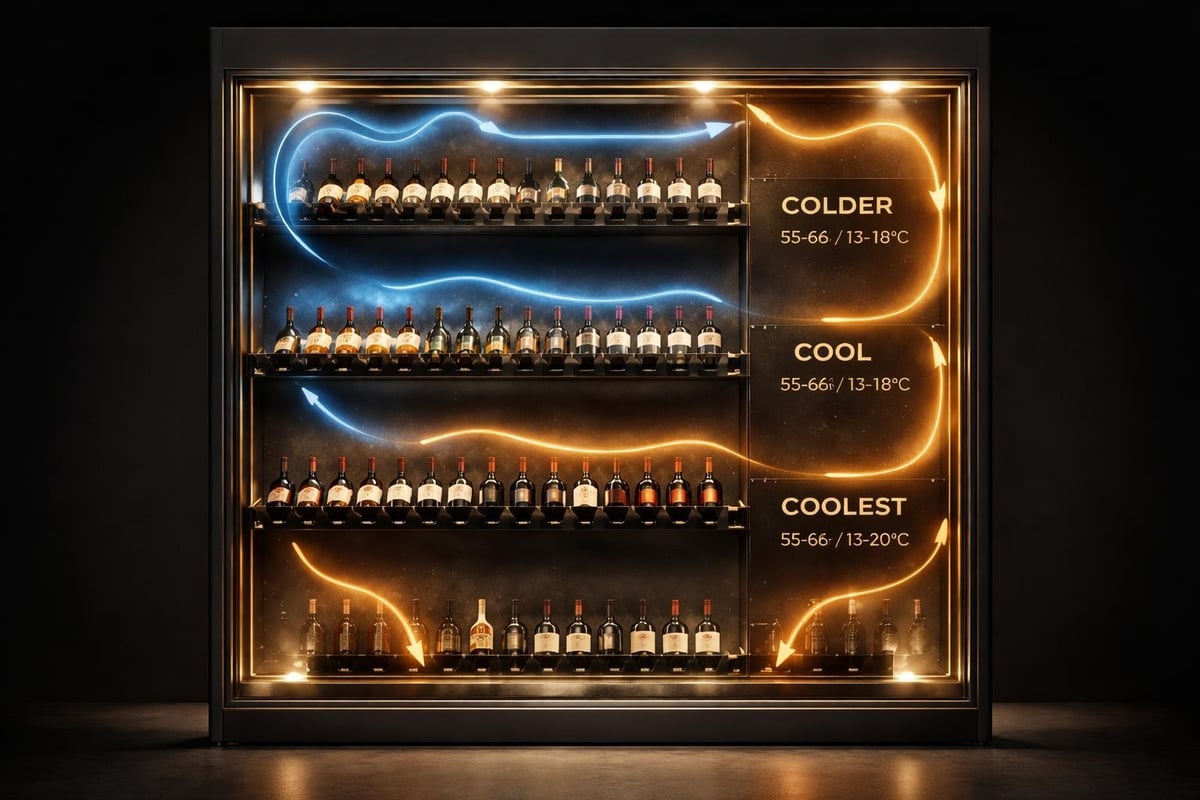
Cable wine displays present unique advantages and considerations for climate management. The open structure facilitates superior air circulation compared to traditional racking, helping maintain consistent temperatures throughout the storage volume.
However, this same openness requires careful integration with HVAC systems. Proper climate design ensures:
Temperature stability within ±2°F of target (typically 55-58°F)
Humidity control maintaining 60-70% relative humidity
Air movement that prevents stratification without creating drafts
Vibration isolation protecting wines from mechanical disturbance
The minimal mass of cable systems means they respond quickly to temperature changes. This requires more responsive climate control than heavy wooden racking systems that provide thermal mass buffering. Quality cellar cooling units with precise digital controls become essential rather than optional.
Lighting Integration Strategies
Cable displays offer exceptional opportunities for dramatic lighting effects. The open structure allows light to play through the bottles, creating jewel-like effects that enhance visual impact.
Recommended lighting approaches:
LED strip lighting mounted at ceiling level washing down cable runs
Individual bottle spotlighting from ceiling-mounted track systems
Backlit panels behind displays creating silhouette effects
RGB color-changing systems for entertainment venues seeking drama
All lighting must generate minimal heat to avoid compromising climate control. Modern LED technology makes this achievable while providing excellent color rendering that showcases wine labels and bottle colors accurately.
Maintenance and Long-Term Performance
Cable wine displays require minimal maintenance when properly installed, but periodic attention ensures decades of flawless performance. The inherent durability of stainless steel components resists the environmental factors that degrade traditional materials.
Annual maintenance tasks include:
Cable tension verification and adjustment if needed
Cradle alignment inspection and correction
Hardware tightness verification at all anchor points
Surface cleaning using appropriate non-abrasive methods
Climate system filter changes and performance verification
The modular design simplifies future modifications. Adding capacity or reconfiguring bottle spacing requires only installing additional cables and cradles rather than rebuilding entire sections. This flexibility protects your investment as collection needs evolve.
Addressing Common Performance Issues
Well-designed cable systems rarely develop problems, but understanding potential issues helps maintain perfection:
Issue | Likely Cause | Resolution |
|---|---|---|
Cable loosening | Settling or temperature cycling | Re-tension using turnbuckles |
Cradle misalignment | Improper initial installation | Adjust individual cradle positions |
Surface corrosion | Harsh cleaning products | Polish with appropriate stainless cleaner |
Bottle stability concerns | Incorrect cradle angle | Adjust mounting brackets |
Professional maintenance through experts familiar with wine cellar materials and systems ensures these systems maintain showroom condition indefinitely.
Cost Considerations and Value Analysis
Cable wine displays represent a significant investment that delivers exceptional returns through longevity, flexibility, and aesthetic impact. Understanding cost drivers helps make informed decisions aligned with your priorities and budget.
Primary cost factors include:
System complexity - Single-run installations versus multi-section designs
Finish selection - Standard stainless versus premium brass or custom colors
Capacity - Total bottle count drives material quantities
Structural requirements - Existing conditions versus new construction
Installation complexity - Accessibility and site-specific challenges
Residential installations typically range from $150 to $400 per linear foot depending on specifications and finishes. Commercial projects benefit from economies of scale, with larger installations potentially reducing per-foot costs while adding complexity in coordination and scheduling.
The visual refinement and engineering precision justify premium pricing through exceptional longevity and timeless design that resists obsolescence.
When evaluating costs, consider lifecycle value rather than just initial investment. Cable displays require virtually no replacement or significant maintenance over decades, unlike wood racking that may need refinishing or metal racks that corrode. The total cost of ownership often proves lower despite higher initial expenditure.
Combining Cable Systems With Traditional Elements
Many of the most compelling wine cellar designs blend cable displays with complementary storage approaches, creating dynamic compositions that serve both functional and aesthetic purposes.
Effective combination strategies:
Cable displays for featured bottles and special vintages
Traditional wood racking for bulk storage and everyday drinking wines
Metal wall racks for magnums and large-format bottles
Drawer systems for horizontal storage of age-worthy wines
This layered approach optimizes each storage type for its ideal purpose while creating visual interest through material and form contrast. The transparency of cable systems provides relief from the visual weight of solid racking, making cellars feel more spacious and inviting.
In modern wine cellar designs, cable displays often anchor the composition as hero elements, with supporting racking providing functional capacity in less prominent zones. This hierarchy guides visitor attention while maximizing storage efficiency.
The integration works particularly well in transitional wine cellars where blending contemporary and traditional elements creates spaces that feel both timeless and current.
Custom Solutions for Unique Architectural Challenges
Cable wine displays excel in addressing challenging spatial conditions that would complicate traditional racking approaches. The system's inherent flexibility adapts to irregular ceiling heights, angled walls, structural columns, and other architectural realities.
Specialized applications include:
Curved wall installations following radius contours
Stair underutilization maximizing otherwise wasted space
Sloped ceiling adaptation in attic or bonus room conversions
Structural column integration turning obstacles into features
Multi-height compositions creating dynamic visual rhythms
These custom solutions transform architectural constraints into design opportunities. Rather than fighting the space, skilled designers use cable systems to emphasize unique characteristics that give each cellar distinctive personality.
Projects in our portfolio of designs demonstrate how cable displays adapt to everything from compact urban apartments to expansive estate wine rooms, each solution precisely tailored to its context.
The engineering tolerances allow for field adjustments during installation, accommodating the inevitable variations between architectural drawings and as-built conditions. This flexibility reduces project risk while ensuring finished quality meets exacting standards.
The Future of Wine Display Innovation
Cable wine display technology continues evolving, incorporating new materials, smart features, and sustainable practices that enhance performance while reducing environmental impact.
Emerging trends include:
Integration of environmental sensors monitoring temperature and humidity at bottle level
LED label illumination creating rotating featured bottle highlights
App-controlled inventory management tracking bottles through RFID or vision systems
Recycled and sustainable materials meeting LEED and environmental standards
Seismic engineering for installations in earthquake-prone regions
These innovations build on the proven foundation of cable systems while expanding capabilities for tech-savvy collectors and commercial operators seeking competitive differentiation. The transformation of wine collections into art pieces continues advancing through both aesthetic refinement and technical enhancement.
As climate change impacts wine production and collecting patterns shift toward smaller, more curated collections of exceptional bottles, display systems that emphasize quality over quantity become increasingly relevant. Cable displays perfectly align with this trend, offering the flexibility to showcase each bottle as an individual treasure rather than merely storing volume.
Cable wine displays represent the pinnacle of engineering-driven design, combining structural precision with aesthetic transparency to transform wine storage into architectural statement. These systems deliver unmatched flexibility, longevity, and visual impact for collectors and commercial operators who refuse to compromise on quality. Prestige Wine Cellars brings decades of expertise to every cable display installation, from initial structural analysis through final tensioning and beyond, ensuring your wine showcase performs flawlessly while expressing your unique vision. Contact our design team to explore how cable systems can elevate your collection into a work of art.
Your Dream Wine Cellar Starts Here
Let our design team craft a cellar that matches your taste, space, and your collection — built for beauty, function, and prestige.

Email us at
Serving Austin, Dallas–Fort Worth, Houston & San Antonio