
Wine Guardian D050: Expert Guide to Premium Cooling
Discover why the Wine Guardian D050 is the gold standard for medium-sized wine cellars. Expert insights on performance, installation, and features.
When designing a luxury wine cellar that will protect your investment for decades, choosing the right climate control system is paramount. The wine guardian d050 represents a sweet spot in commercial-grade cooling technology, offering the precision and reliability that serious collectors demand while fitting seamlessly into medium-sized residential and commercial installations. This ducted cooling unit has earned its reputation among wine cellar professionals as a dependable workhorse that delivers consistent temperature and humidity control without compromise.
Understanding the Wine Guardian D050 Specifications
The wine guardian d050 stands out in the Wine Guardian lineup as a ducted cooling system designed specifically for wine cellars ranging from 400 to 1,000 cubic feet. This capacity makes it ideal for dedicated wine rooms in private estates, upscale restaurants, and boutique hotels where space and collection size demand professional-grade climate control.
Key performance metrics include:
Cooling capacity: 6,000 BTU/hr
Temperature range: 50°F to 65°F with ±2°F precision
Humidity control: 50% to 70% relative humidity
Power requirements: 115V/60Hz single-phase
Dimensions: Compact footprint suitable for mechanical rooms or attics
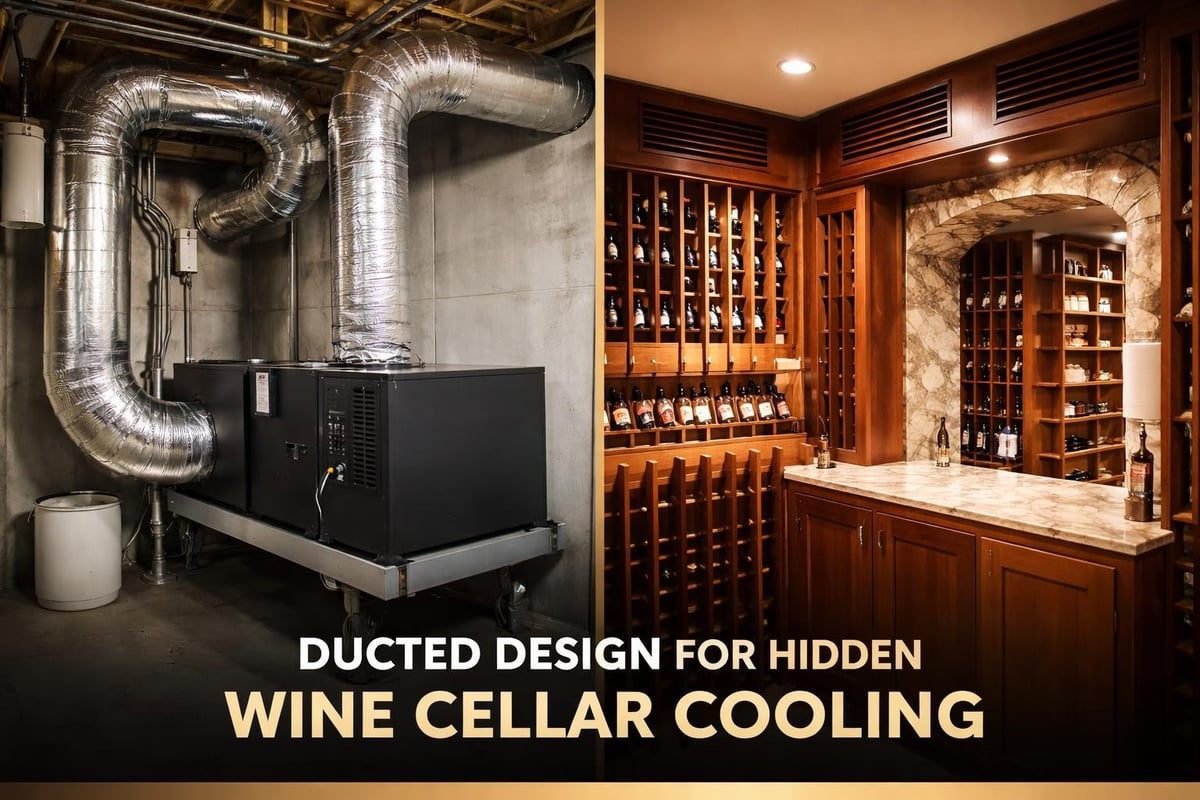
The unit operates on a simple yet effective principle: warm air from the wine cellar is drawn through ductwork, cooled and dehumidified, then returned through separate supply ducts. This ducted design keeps the mechanical components completely separate from your collection, eliminating noise and vibration within the cellar itself.
Why Ducted Systems Outperform Through-Wall Units
The ducted configuration of the wine guardian d050 offers distinct advantages over through-wall alternatives. Remote installation means you can position the unit in a utility room, attic, or basement while maintaining the aesthetic integrity of your wine cellar design. This flexibility proves invaluable when designing custom wine cellars where every visible element contributes to the overall ambiance.
The separation also enables better noise management. With the compressor and fans operating away from your tasting area, conversations and contemplative moments remain undisturbed. This consideration becomes especially important in commercial settings like steakhouses or wine bars where ambient noise affects the guest experience.
Installation Requirements and Considerations
Proper installation of the wine guardian d050 determines its long-term performance and efficiency. The comprehensive installation manual provides detailed guidance, but several critical factors deserve special attention during planning.
Essential installation elements:
Adequate clearance around the unit for airflow and service access
Proper duct sizing to maintain airflow without restriction
Condensate drainage with appropriate pitch and trap configuration
Electrical service meeting local codes and manufacturer specifications
Insulated ductwork to prevent thermal loss and condensation
The wine guardian d050 requires dedicated electrical service on a 20-amp circuit. While the unit draws modest power during normal operation, startup current demands proper circuit protection. Working with licensed electricians ensures code compliance and reliable operation.
Ductwork Design for Optimal Performance
Ductwork represents the circulatory system of your climate control solution. The wine guardian d050 performs best with properly sized supply and return ducts that minimize static pressure while delivering even air distribution throughout the cellar. Six-inch diameter ducts typically serve residential installations, though larger cellars may benefit from eight-inch runs to reduce velocity and noise.
Ductwork best practices:
Component | Specification | Purpose |
|---|---|---|
Supply Duct | 6" insulated flex or rigid | Delivers conditioned air to cellar |
Return Duct | 6" insulated flex or rigid | Removes warm, humid air |
Duct Insulation | R-6 minimum | Prevents condensation and heat gain |
Diffusers | Low-velocity ceiling or wall | Even air distribution |
Dampers | Adjustable balancing | Fine-tune airflow patterns |
Strategic diffuser placement prevents direct airflow on wine bottles while ensuring complete air circulation. Corner-mounted or ceiling-integrated diffusers work beautifully in most cellar layouts, and adjustable dampers allow fine-tuning after installation based on observed performance.
Advanced Features and Optional Enhancements
The wine guardian d050 comes equipped with sophisticated controls that simplify operation while providing precise environmental management. The standard digital controller monitors temperature and humidity continuously, adjusting compressor and fan operation to maintain your specified conditions.
The unit's microprocessor manages several protective features automatically. Short-cycle prevention protects the compressor from premature failure, while high-pressure cutoffs guard against refrigerant issues. Temperature alarms alert you to conditions outside your specified range, providing peace of mind whether you're home or traveling.
Humidification Integration for Complete Control
Wine storage requires not just cool temperatures but also appropriate humidity levels. Too dry, and corks shrink, allowing air infiltration. Too humid, and labels deteriorate while mold risks increase. The wine guardian d050 integrates seamlessly with the Sentinel Series Integrated Humidifier, creating a complete climate management system.
This factory-matched humidifier mounts directly to the cooling unit and operates under the same controller. The integrated approach ensures temperature and humidity work in concert rather than competing, delivering the stable 55°F to 60°F and 60% to 70% humidity that fine wines demand.
Benefits of integrated humidification:
Single-point control for temperature and humidity
Factory-calibrated sensors for accuracy
Automatic operation based on cellar conditions
Reduced maintenance compared to standalone units
Coordinated operation prevents overcooling during humidification
Sizing Considerations and Heat Load Calculations
Selecting the wine guardian d050 requires understanding your specific cooling requirements. While the unit handles 400 to 1,000 cubic feet comfortably under typical conditions, several factors influence actual performance and suitability for your project.
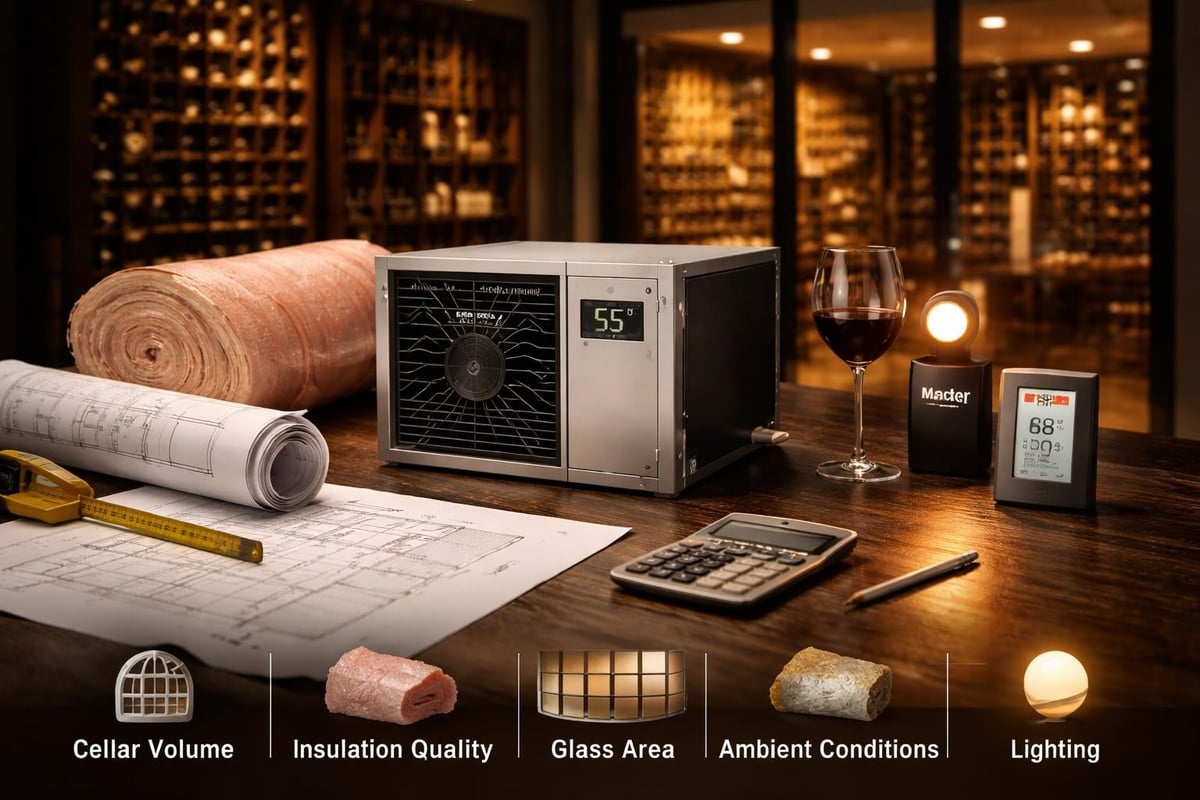
Critical sizing factors include:
Cellar volume measured in cubic feet
Insulation quality of walls, ceiling, and floor
Glass area and thermal properties
Ambient temperature surrounding the cellar
Door traffic frequency and duration
Lighting heat load from fixtures inside the cellar
Using a heat load calculator removes guesswork from equipment selection. These tools account for all heat sources and insulation values, producing accurate BTU requirements that ensure your cooling system operates efficiently without cycling excessively or running continuously.
When to Upsize or Consider Alternative Models
The wine guardian d050 represents optimal value for medium cellars, but larger installations or challenging conditions may warrant the D100 or D200 models. Glass-walled cellars particularly demand careful evaluation, as glass conducts heat far more readily than insulated walls.
As a general rule, if your calculated heat load exceeds 5,500 BTU/hr, or if your cellar contains more than 30% glass walls, consulting with experienced designers prevents costly mistakes. Professional wine cellar builders factor in not just current conditions but future expansion plans, ensuring your climate system accommodates growth.
Maintenance Requirements for Long-Term Reliability
The wine guardian d050 delivers decades of reliable service when properly maintained. Like any mechanical system, preventive care prevents problems and extends equipment life. Fortunately, routine maintenance remains straightforward and manageable for most owners.
Essential quarterly maintenance tasks:
Inspect and clean condenser coils
Check condensate drain for blockage
Replace or clean air filters
Verify temperature and humidity accuracy
Listen for unusual noises or vibrations
Condenser coils accumulate dust and debris that insulate them, reducing heat transfer efficiency. Cleaning these coils quarterly with a soft brush and gentle vacuum maintains optimal performance. In dusty environments or locations near kitchen exhaust, monthly cleaning may prove necessary.
Professional Service and Troubleshooting
While routine maintenance suits do-it-yourself approaches, annual professional service provides deeper inspection and system optimization. Technicians check refrigerant charge, inspect electrical connections, verify control calibration, and assess overall system health.
The detailed specification sheet provides troubleshooting guidance for common issues. However, refrigerant work requires EPA certification, and electrical repairs demand appropriate licensing. Working with authorized service providers protects your warranty and ensures proper repairs.
Maintenance Task | Frequency | DIY or Professional |
|---|---|---|
Filter cleaning/replacement | Monthly | DIY |
Condenser coil cleaning | Quarterly | DIY |
Condensate drain inspection | Quarterly | DIY |
Control calibration check | Annually | Professional |
Refrigerant charge verification | Annually | Professional |
Electrical connection inspection | Annually | Professional |
Real-World Applications and Performance
The wine guardian d050 serves diverse installation types, from intimate residential collections to commercial applications in restaurants and hotels. Understanding how the unit performs in different scenarios helps set realistic expectations and identify ideal use cases.
Residential Wine Cellar Performance
In home installations, the wine guardian d050 excels at maintaining precise conditions in dedicated cellar spaces ranging from walk-in closets to basement rooms. Homeowners appreciate the quiet operation afforded by remote ducted installation, particularly in open-concept floor plans where noise travels easily.
A typical residential installation might serve a 12-foot by 10-foot cellar with 8-foot ceilings, housing 800 to 1,200 bottles depending on racking configuration. When properly insulated and sealed, the wine guardian d050 maintains 55°F with minimal runtime, often cycling just a few times per hour even during Texas summers.
Residential installation success factors:
Professional vapor barrier installation prevents moisture infiltration
Properly sized and sealed door reduces thermal loss
LED lighting minimizes heat generation
Strategic vent placement ensures even temperature distribution
Commercial Applications in Hospitality
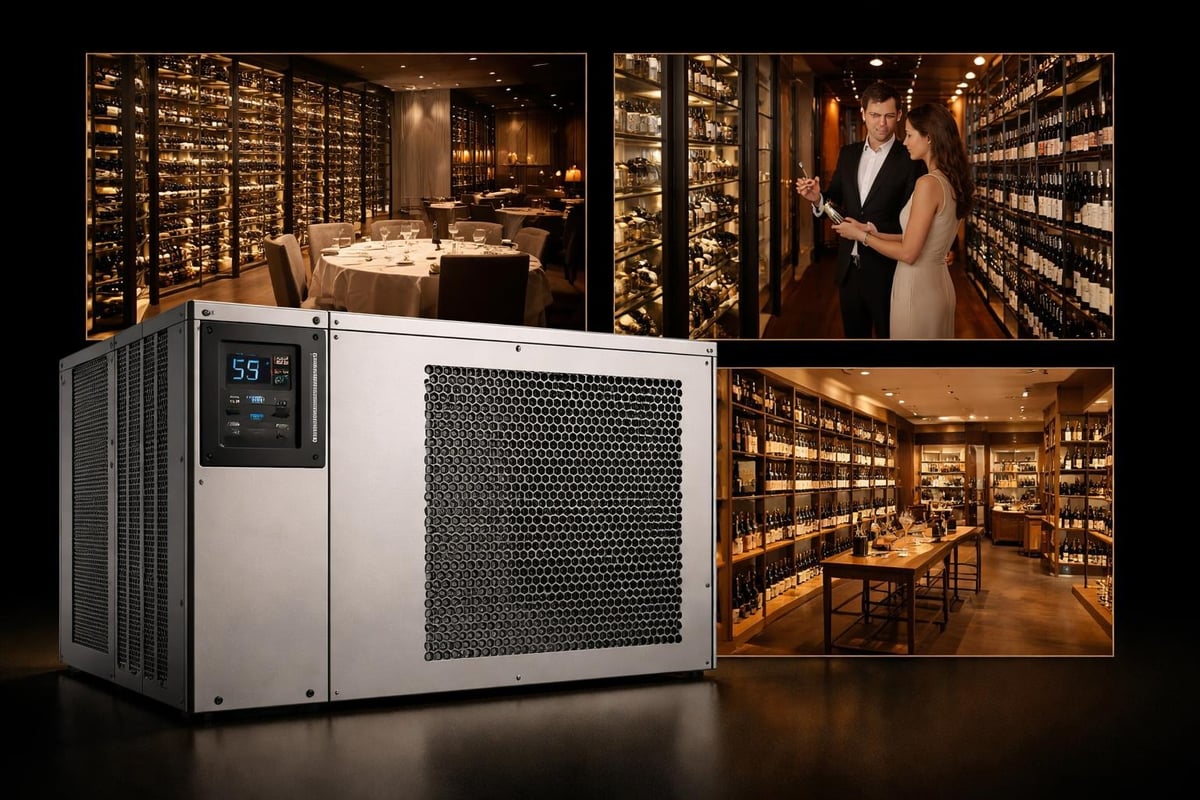
Restaurants, wine bars, and hotels present unique challenges that the wine guardian d050 handles admirably. Higher door traffic, display lighting, and aesthetic requirements demand both performance and flexibility. The ducted design particularly shines in these applications, allowing complete mechanical concealment while delivering commercial-grade reliability.
Modern wine wall installations in upscale steakhouses often feature floor-to-ceiling glass showcasing hundreds of bottles. The wine guardian d050 maintains perfect conditions behind these dramatic displays, with ductwork concealed in ceiling plenums or adjacent mechanical spaces.
Comparing D050 to Competitive Systems
The wine cellar cooling market offers numerous options, from budget split systems to ultra-premium self-contained units. The wine guardian d050 occupies a premium middle position, delivering commercial reliability at residential price points. Understanding these comparisons helps justify the investment.
Wine Guardian D050 advantages over competitors:
Ducted flexibility allows creative installation solutions
Integrated controls simplify operation and monitoring
Factory support provides direct technical assistance
Proven reliability backed by thousands of installations
Upgrade path to humidification and advanced controls
Compared to through-wall units in the same price range, the wine guardian d050 offers superior aesthetics and noise performance. Against higher-priced self-contained systems, it delivers comparable climate control at significantly lower cost. The official product page details technical specifications that support these comparisons.
Total Cost of Ownership Considerations
Initial equipment cost represents just one element of long-term value. The wine guardian d050 delivers favorable total cost of ownership through energy efficiency, reliability, and serviceability. The unit's efficient compressor and fan motors consume modest power, typically 8 to 12 amps during operation.
Long-term value factors:
Factor | Wine Guardian D050 | Budget Alternatives | Premium Self-Contained |
|---|---|---|---|
Initial Cost | $$$ | $$ | $$$$ |
Installation Complexity | Moderate | Low | Low-Moderate |
Energy Efficiency | Excellent | Good | Excellent |
Noise Level | Very Low (ducted) | Moderate | Low |
Serviceability | Excellent | Fair | Good |
Expected Lifespan | 15-20 years | 8-12 years | 15-20 years |
Integration with Wine Cellar Design Aesthetics
The wine guardian d050's ducted configuration liberates designers from equipment placement constraints that compromise aesthetics. Supply and return vents can be elegantly integrated into millwork, ceiling details, or architectural features that enhance rather than detract from the cellar's visual impact.
In traditional wine cellar designs featuring extensive wood racking and barrel-vaulted ceilings, small wood-trimmed vents blend seamlessly into the architectural vocabulary. Contemporary glass-enclosed showpieces often incorporate linear slot diffusers that appear as intentional design elements rather than mechanical necessities.
Design integration strategies:
Ceiling-mounted slot diffusers in modern cellars
Wood-grilled vents matching racking materials
Toe-kick returns beneath racking systems
Crown molding concealment in traditional designs
Perimeter slot details in minimalist spaces
Working with experienced wine cellar designers ensures mechanical and aesthetic elements work in harmony. The best cellars reveal their climate control systems only to those who know where to look, maintaining visual purity while delivering flawless environmental control.
Smart Controls and Remote Monitoring Options
Modern wine collectors expect connectivity and remote access to critical systems. While the wine guardian d050 ships with capable digital controls, various third-party monitoring solutions enable smartphone access and automated alerts. These additions transform basic climate control into comprehensive cellar management.
Several manufacturers offer WiFi-enabled thermostats and monitors compatible with the wine guardian d050's control outputs. These devices track temperature and humidity continuously, storing historical data and sending notifications when conditions drift outside acceptable ranges. Some integrate with whole-home automation systems, providing unified control of all building systems.
Remote monitoring benefits:
Real-time temperature and humidity visibility from anywhere
Automated alerts via email or text for alarm conditions
Historical data tracking reveals patterns and trends
Vacation peace of mind knowing conditions remain stable
Integration with smart home ecosystems
For collectors with multiple properties or restaurant groups managing several locations, cloud-based monitoring becomes invaluable. A single dashboard displays all cellar conditions across an entire portfolio, highlighting issues before they threaten valuable inventory.
Technical Support and Warranty Coverage
Wine Guardian backs the D050 with comprehensive warranty coverage and accessible technical support. Understanding these protections and resources helps maximize your investment and resolve issues quickly when they arise.
The standard warranty covers parts for five years and includes one year of labor coverage. Extended warranty options provide additional protection for mission-critical commercial installations where downtime means lost revenue. Authorized dealers often facilitate warranty claims and provide local service networks.
Technical support resources include:
Direct manufacturer support via phone and email
Comprehensive installation and service manuals
Video tutorials for common maintenance tasks
Network of authorized service technicians
Online troubleshooting guides and FAQs
Wine Guardian's technical support team possesses deep product knowledge and typically responds to inquiries within one business day. For urgent issues, phone support connects you directly with technicians who can diagnose problems and recommend solutions. This responsive support distinguishes Wine Guardian from competitors offering only email-based assistance.
Energy Efficiency and Operating Costs
Operating cost consciousness has grown among luxury homeowners and commercial operators alike. The wine guardian d050 delivers impressive energy efficiency through modern compressor technology, variable-speed fans, and intelligent control algorithms that minimize unnecessary runtime.
In typical residential applications with properly insulated cellars, the wine guardian d050 consumes 300 to 500 kilowatt-hours monthly, translating to $30 to $60 in electricity costs depending on local rates. Commercial applications with higher traffic and lighting loads may see 600 to 800 kWh monthly consumption.
Energy efficiency optimization strategies:
Maximize insulation values in walls, ceiling, and floor
Minimize glass area or specify high-performance glazing
Use LED lighting exclusively to reduce heat load
Install automatic door closers to prevent thermal loss
Schedule lighting to minimize runtime during unoccupied periods
The unit's efficient operation also reduces environmental impact, an increasingly important consideration for LEED-certified buildings and sustainability-focused owners. Compared to older cooling technologies, the wine guardian d050 uses modern refrigerants with lower global warming potential while consuming less energy per BTU of cooling delivered.
Noise Performance in Shared Spaces
Acoustic performance often receives insufficient attention during equipment selection, yet it profoundly affects living comfort and guest experience. The wine guardian d050's ducted configuration inherently provides excellent noise isolation by locating mechanical components away from occupied spaces.
Typical sound levels in the wine cellar itself measure 30 to 35 decibels when the system operates, comparable to a quiet library or soft whisper. This exceptional quietness results from careful component selection, vibration isolation, and the acoustic damping that properly insulated ductwork provides.
In the mechanical room housing the unit, sound levels reach 55 to 60 decibels, similar to normal conversation volume. Strategic placement away from bedrooms and living spaces, combined with basic sound insulation in mechanical room walls, prevents any disturbance to occupants.
Noise reduction techniques:
Install unit on vibration-isolating mounting pads
Use flexible duct connectors to prevent vibration transmission
Insulate mechanical room walls and doors
Locate unit as far as practical from quiet spaces
Consider acoustic duct lining in proximity to bedrooms
For wine cellars in urban residences where space limitations force mechanical rooms adjacent to living areas, these acoustic strategies become essential rather than optional.
The wine guardian d050 represents a proven solution for discerning collectors and commercial operators who refuse to compromise on climate control quality. Its ducted design, precise controls, reliable performance, and integration flexibility make it the natural choice for medium-sized wine cellars where protecting valuable collections demands professional-grade equipment. Whether you're planning an intimate residential cellar or a showpiece wine room for your restaurant, Prestige Wine Cellars brings decades of expertise in matching climate control technology to unique project requirements, ensuring your collection receives the protection it deserves while your design vision comes to life flawlessly.
Your Dream Wine Cellar Starts Here
Let our design team craft a cellar that matches your taste, space, and your collection — built for beauty, function, and prestige.

Email us at
Serving Austin, Dallas–Fort Worth, Houston & San Antonio