
In Floor Wine Cellar: Design & Installation Guide 2026
Discover how in floor wine cellars maximize space and create stunning underground storage. Expert design, engineering, and installation insights.
An in floor wine cellar represents the pinnacle of sophisticated wine storage, transforming underutilized space beneath your home into a temperature-controlled sanctuary for your most treasured bottles. Unlike traditional above-ground cellars, these below-grade installations offer natural thermal advantages, exceptional space efficiency, and an element of discovery that captivates both collectors and guests. Whether you're designing a private estate in the Texas Hill Country or retrofitting a historic Houston residence, understanding the nuances of in floor cellar construction ensures your investment delivers lasting value and optimal aging conditions for decades to come.
Why Choose an In Floor Wine Cellar
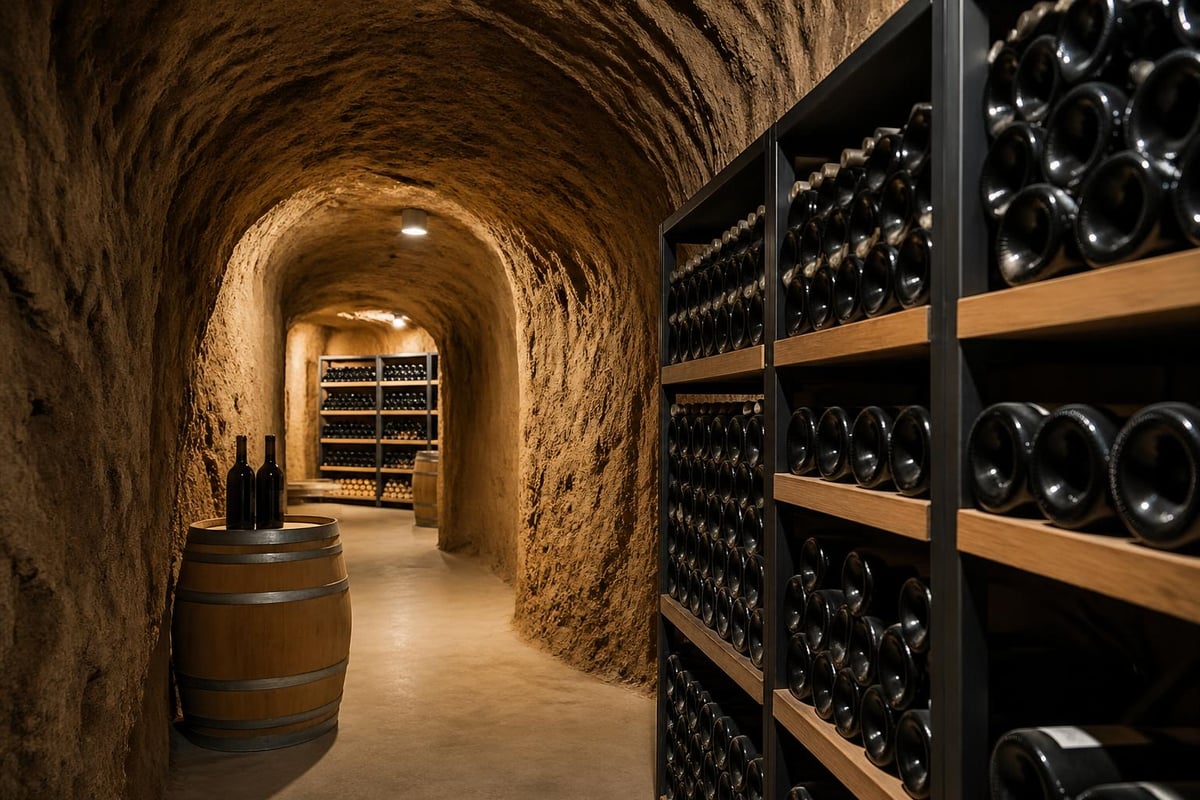
The decision to build an in floor wine cellar goes beyond aesthetics. These underground installations leverage the earth's natural insulation properties, creating inherently stable environments that require less mechanical intervention to maintain ideal temperatures between 55-58°F and humidity levels around 60-70%.
Key advantages include:
Natural temperature stability from earth insulation, reducing energy consumption
Space optimization that doesn't compromise living areas above
Noise reduction from cooling systems tucked away from main living spaces
Enhanced property value through unique architectural features
Privacy and security for valuable collections
The earth surrounding an in floor wine cellar acts as a thermal mass, buffering against temperature fluctuations that plague above-ground storage. This natural advantage means your cooling system works less aggressively, extending equipment lifespan while lowering operational costs. For collectors in Central Texas where summer temperatures regularly exceed 100°F, this benefit becomes particularly valuable.
Space Planning Considerations
Before excavation begins, careful spatial analysis determines feasibility and design parameters. An in floor wine cellar typically requires minimum ceiling heights of 7-8 feet after excavation, adequate drainage solutions, and proper access planning. The location selection process involves evaluating soil conditions, water tables, existing foundation structures, and utility line placement.
Most successful installations fall within these dimensions:
Cellar Size | Bottle Capacity | Typical Footprint | Excavation Depth |
|---|---|---|---|
Intimate | 500-1,000 | 80-120 sq ft | 8-9 feet |
Standard | 1,000-2,500 | 120-200 sq ft | 8-10 feet |
Expansive | 2,500-5,000+ | 200-400 sq ft | 9-12 feet |
Access represents a critical design element. Will you descend through a trapdoor entry in your dining room floor, creating dramatic reveal moments? Or does a traditional staircase from a butler's pantry better serve your lifestyle? Each approach impacts both construction logistics and daily usability.
Structural Engineering and Foundation Requirements
Creating an in floor wine cellar demands rigorous structural engineering that extends far beyond typical basement conversions. The excavation process must account for existing foundation loads, soil bearing capacity, and potential groundwater intrusion. Professional structural planning for underground wine storage ensures your cellar remains stable, dry, and secure for generations.
Foundation Integration Methods
Three primary approaches dominate in floor wine cellar construction:
New construction integration offers the cleanest path, incorporating the cellar into initial foundation plans. This approach allows optimal placement, simplified waterproofing, and coordinated utility rough-ins. For those building estates in areas like Dripping Springs or Horseshoe Bay, this timing proves ideal.
Retrofit excavation requires working within existing structures, demanding careful underpinning of surrounding foundation elements. Engineers assess load-bearing walls, calculate temporary support requirements, and sequence excavation to prevent settlement. This complexity adds cost but enables transformation of established homes.
Adjacent expansion involves excavating beyond the existing foundation footprint, then connecting through basement or ground-floor access points. This method minimizes disruption to occupied spaces while still achieving below-grade benefits.
All approaches require robust waterproofing systems. We're not just preventing minor seepage; we're creating a permanently dry environment where moisture control becomes critical to wine preservation. Premium installations utilize multiple redundant waterproofing layers:
External membrane application on excavated walls before backfill
Interior drainage systems with sump pump backup
Crystalline waterproofing in concrete mix for molecular-level protection
Vapor barrier integration coordinated with climate control needs
Climate Control Engineering for Below-Grade Environments
The in floor wine cellar's underground position fundamentally changes climate control requirements compared to above-ground installations. While earth insulation provides natural advantages, it also creates unique challenges around moisture management, ventilation, and equipment placement that demand specialized expertise from custom wine cellar design professionals.
Cooling System Selection
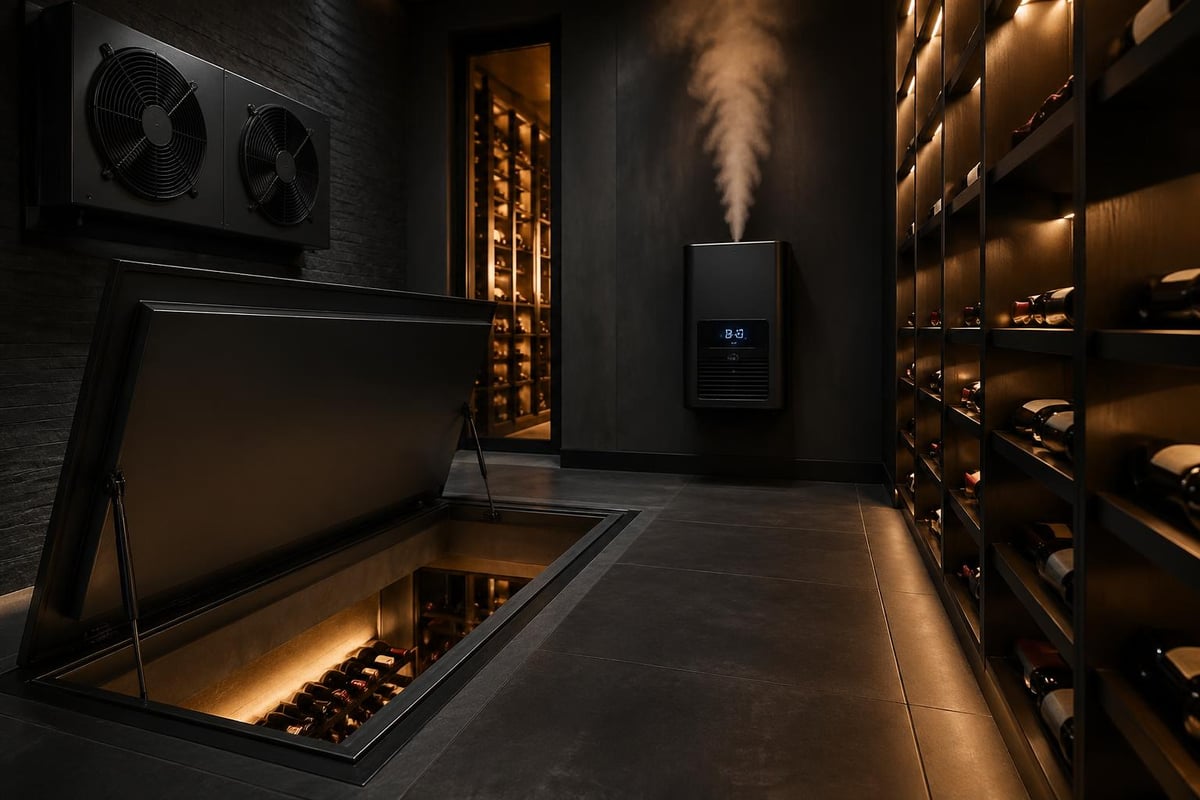
Underground cellars typically require ducted cooling systems rather than through-wall units common in above-grade applications. The cooling unit itself resides in a mechanical room or outdoor location, while supply and return ducts deliver conditioned air to the cellar space. This separation prevents equipment heat from affecting cellar temperatures and reduces noise within your wine storage sanctuary.
Capacity calculations must account for:
Below-grade thermal load (generally lower than above-grade spaces)
Insulation R-values in walls, ceiling, and floor assembly
Door infiltration during access events
Lighting heat gain from display illumination
Occupancy patterns for tastings or entertaining
The three critical components of construction directly impact cooling efficiency: insulation (minimum R-19 walls, R-30 ceiling), vapor barriers (6-mil poly on warm side), and airtight seals (weatherstripping, door sweeps, caulked penetrations).
Humidity and Ventilation Balance
An in floor wine cellar naturally tends toward higher humidity due to earth contact and cooler temperatures, which can be advantageous or problematic depending on management. Target humidity of 60-70% prevents cork drying while avoiding label damage or mold growth.
Active humidity control involves:
Standalone humidifiers with automatic sensors for dry climates
Dehumidification capacity within cooling units for humid regions
Strategic air circulation preventing stagnant pockets
Humidity monitoring with remote alert systems
Texas presents unique challenges. Austin's average annual humidity hovers around 65%, while coastal Houston reaches 75%. An in floor wine cellar in Houston requires more aggressive dehumidification than one in drier Fredericksburg. Understanding regional microclimates shapes equipment specifications and operating parameters.
Construction Process and Timeline
Building an in floor wine cellar follows a methodical sequence that typically spans 12-20 weeks from excavation to final commissioning. This timeline assumes retrofit installation; new construction integration may compress certain phases while extending others based on overall building schedules.
Phase | Duration | Key Activities |
|---|---|---|
Engineering & Permits | 3-4 weeks | Structural plans, soil testing, permit applications |
Excavation & Foundation | 4-6 weeks | Dig-out, waterproofing, concrete pour and cure |
MEP Rough-Ins | 2-3 weeks | Electrical, cooling ducts, drainage installation |
Framing & Insulation | 2 weeks | Wall framing, insulation, vapor barrier application |
Finishes & Racking | 3-4 weeks | Walls, flooring, millwork, racking installation |
Systems Commissioning | 1 week | Cooling system startup, testing, balancing |
The step-by-step preparation process ensures each phase builds properly on previous work. Rushing installation compromises long-term performance, particularly in critical areas like waterproofing cure times and vapor barrier sealing.
Excavation Considerations
Removing earth for an in floor wine cellar demands more than basic digging. Soil characterization determines shoring requirements, with clay-heavy Texas soils behaving differently than sandy or rocky compositions. Excavation typically proceeds in stages, allowing engineers to confirm soil conditions match initial assessments.
Spoil removal represents a significant logistical element. A 200-square-foot cellar excavated 9 feet deep generates approximately 65 cubic yards of earth, enough to fill several dump trucks. Site access for equipment and material removal must be planned, particularly for established neighborhoods with mature landscaping or narrow driveways.
Material Selection and Interior Design
The interior finishes of your in floor wine cellar balance aesthetics, durability, and functional performance. Unlike living spaces where design preferences dominate, wine cellars demand materials that withstand high humidity, resist mold, and contribute to thermal stability while still expressing your personal style.
Wall and Ceiling Treatments
Moisture-resistant materials form the foundation of any specification. Wine cellar material choices typically include:
Closed-cell spray foam insulation (R-6 to R-7 per inch) that serves dual duty as vapor barrier
Cement board or marine-grade plywood as substrate for finish materials
Tongue-and-groove wood planking in moisture-tolerant species (redwood, mahogany, cedar)
Stone or tile finishes over waterproof membranes for contemporary aesthetics
The design guide for construction emphasizes that all wood must acclimate to cellar conditions before installation. Pre-finishing wood components in controlled environments prevents warping or splitting once installed in your high-humidity in floor wine cellar.
Ceiling treatments warrant special attention. Many designers incorporate vaulted or barrel-vault ceilings to enhance the underground ambiance while improving air circulation. Recessed LED lighting with warm color temperatures (2700-3000K) highlights bottles without generating excessive heat or UV exposure.
Flooring Options
The floor of an in floor wine cellar sits directly on or near the concrete foundation, requiring materials that tolerate moisture migration while providing aesthetic appeal. Popular choices include:
Polished concrete with integral color or stains for modern industrial looks
Porcelain or ceramic tile in stone-look patterns for traditional elegance
Engineered hardwood with vapor barrier underlayment for warmth
Natural stone (slate, travertine, limestone) for Old World character
Each material carries different installation requirements. The comprehensive construction guide notes that any wood flooring needs expansion gaps to accommodate dimensional changes, while stone requires appropriate setting materials that remain flexible in cooler temperatures.
Racking Systems and Storage Capacity
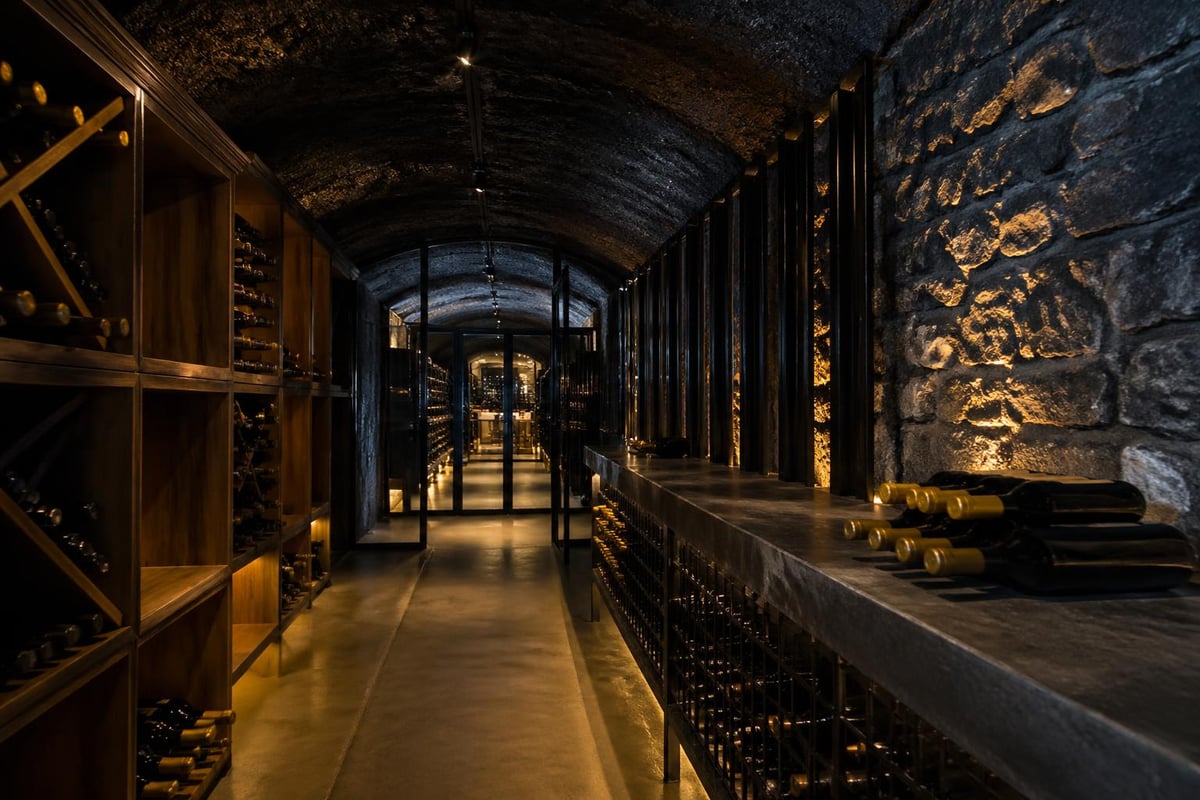
An in floor wine cellar's storage capacity depends on racking configuration, bottle sizes accommodated, and display versus bulk storage priorities. Custom millwork maximizes every cubic foot while creating visual interest through varied racking depths, heights, and styles.
Calculating Capacity
Standard 750ml bottles serve as the baseline for capacity calculations. Individual bottle racking (fully visible labels) consumes roughly 4-5 bottles per cubic foot of racking space, while bin storage (bulk stacking) achieves 8-12 bottles per cubic foot. Most collectors prefer a blend of both approaches.
For a 150-square-foot in floor wine cellar with 8-foot ceilings:
Wall racking (three walls): 100 linear feet × 7-foot height = 700 sq ft of racking face
Standard racking depth: 14 inches
Usable cubic footage: Approximately 80 cubic feet
Mixed capacity: 1,800-2,400 bottles
This assumes center floor space for tasting table or display elements. Pure storage maximization could exceed 3,000 bottles in the same footprint through high-density bin configurations.
Racking Material Considerations
Wine cellar materials for racking systems each bring distinct advantages:
Wood racking offers warmth and traditional appeal. Species like mahogany, walnut, and redwood resist moisture damage while developing rich patina over time. Premium installations feature dovetail joinery, hand-applied finishes, and adjustable shelving that adapts to collection evolution.
Metal racking in powder-coated steel or wrought iron creates contemporary statements, particularly in modern wine cellar designs. The material's strength enables dramatic cantilevers and floating shelf effects impossible with wood alone.
Acrylic or glass integration adds visual lightness, particularly effective for showcasing prestigious bottles. LED backlighting transforms transparent racking into focal points that draw the eye while maintaining optimal storage conditions.
Access and Entry Design
The entry to an in floor wine cellar establishes the experience, whether dramatic revelation through floor hatches or gradual descent via traditional staircases. This design decision impacts construction costs, daily usability, and resale appeal while reflecting your personal style and how you share your collection.
Trapdoor and Lift Systems
Floor hatch entries create unforgettable moments. Imagine entertaining in your dining room when you activate a motorized hatch, revealing a illuminated staircase descending into your collection below. These systems require:
Structural framing to support hatch weight and mechanism
Hydraulic or electric lift systems with safety interlocks
Flush floor integration matching surrounding finishes
Backup manual operation for power failures
Spiral staircases maximize spatial efficiency within the hatch opening, requiring as little as 5 feet of diameter while still meeting code requirements. Straight-run stairs demand more floor space but offer easier bottle transport and accessibility for all ages.
Traditional Staircase Integration
Conventional staircases from adjacent spaces provide straightforward access while establishing transition zones between everyday living and wine sanctuary. A staircase from a butler's pantry, for instance, reinforces the connection between wine storage and entertaining while providing convenient bottle retrieval during dinner parties.
The design and construction techniques for cellar access emphasize that proper door sealing proves crucial. Insulated, weather-stripped doors with threshold seals prevent conditioned air loss, while glass panel inserts maintain visibility without compromising thermal performance.
Lighting Design for Drama and Function
Thoughtful illumination transforms an in floor wine cellar from mere storage into an experiential space that celebrates your collection. The challenge lies in providing adequate visibility for label reading and bottle selection while minimizing heat generation and avoiding UV damage that degrades wine over time.
Layered Lighting Approach
Professional installations employ three distinct lighting layers:
Ambient illumination from recessed ceiling fixtures provides overall visibility
Accent lighting highlights architectural features and prized bottles
Task lighting within racking for label examination and inventory management
LED technology dominates modern cellar lighting. These fixtures generate minimal heat compared to incandescent alternatives, operate efficiently, and now offer color rendering indices (CRI) above 90 that accurately represent wine label colors. Dimming capability allows you to adjust intensity based on activity, from intimate tastings to full collection showcases.
Strategic placement includes:
Recessed ceiling cans on 4-6 foot centers for even ambient light
Linear LED strips along racking top edges for bottle neck illumination
Individual bottle spotlights on museum-quality vintages or large formats
Toe-kick lighting at floor level for architectural definition
Motion sensors and timer controls prevent lights from remaining on unnecessarily, reducing energy waste and heat accumulation in your carefully conditioned in floor wine cellar environment.
Technology Integration and Smart Systems
Modern wine collectors expect the same connectivity and automation in their cellars as throughout their homes. An in floor wine cellar provides an ideal environment for integrated technology that monitors conditions, manages inventory, and enables remote access to your collection data from anywhere in the world.
Environmental Monitoring
Continuous monitoring systems track temperature, humidity, and equipment performance, sending alerts when parameters drift outside acceptable ranges. Premium systems offer:
Multiple sensor placement throughout the cellar for microclimate monitoring
Cloud-based data logging with historical trending
Integration with home automation platforms (Control4, Crestron, Savant)
Automatic equipment adjustments based on real-time conditions
These systems prove particularly valuable for hospitality applications where staff monitor multiple cellars across a property or for collectors who travel extensively and want peace of mind that their investment remains protected.
Inventory Management
Digital inventory platforms transform collection management from spreadsheets to sophisticated databases that track:
Feature | Benefit | Application |
|---|---|---|
Barcode scanning | Rapid bottle logging | Adding new acquisitions |
Drinking window alerts | Optimal consumption timing | Collection rotation planning |
Valuation tracking | Insurance documentation | Portfolio management |
Location mapping | Rapid bottle retrieval | Quick access for serving |
Advanced systems integrate with racking design, assigning specific locations to each bottle and guiding you to exact positions within your in floor wine cellar through mobile apps. For serious collectors with thousands of bottles, this technology eliminates frustrating searches and ensures nothing passes its prime window unnoticed.
Maintenance and Long-Term Care
Unlike furniture or décor that you might update every few years, an in floor wine cellar represents a permanent architectural feature designed to serve multiple generations. Proper maintenance protects your construction investment while ensuring optimal aging conditions remain consistent year after year.
Climate System Servicing
Annual professional maintenance of cooling equipment includes:
Refrigerant charge verification and leak testing
Condenser coil cleaning for heat exchange efficiency
Fan motor lubrication and bearing inspection
Electrical connection tightening and amperage verification
Thermostat calibration against certified references
Between professional visits, monthly filter changes (or quarterly for high-efficiency media) maintain airflow and system efficiency. Neglected filters force equipment to work harder, raising energy costs while shortening component lifespan.
The wine cellar maintenance services provided by specialists include not just mechanical systems but also structural inspections, finish touch-ups, and racking adjustments as your collection evolves. This comprehensive approach prevents small issues from becoming expensive repairs.
Moisture Management
Even with perfect initial waterproofing, vigilant moisture monitoring protects your in floor wine cellar from the earth's constant pressure. Quarterly inspections should examine:
Foundation wall surfaces for efflorescence or dampness
Floor perimeter joints for water infiltration
Sump pump operation and discharge line functionality
Dehumidifier reservoir and drainage system performance
Any moisture presence demands immediate investigation. Water in a wine cellar doesn't just threaten labels and wooden racking; it can foster mold growth that compromises both wine quality and indoor air quality throughout your home.
Design Styles and Aesthetic Approaches
Your in floor wine cellar's design should reflect the same aesthetic sensibility as your home's interior while embracing the unique character of an underground sanctuary. From rustic stone grottos evoking European wine caves to sleek contemporary spaces with floating glass displays, the design possibilities span every style preference.
Traditional European Influence
Old World aesthetics celebrate wine's centuries-long heritage through materials and forms that reference historic European cellars. These designs typically incorporate:
Exposed brick or stone walls suggesting ancient construction
Vaulted ceilings in barrel or groin configurations
Wrought iron hardware and decorative elements
Antique furniture pieces for tasting areas
Warm ambient lighting from wall sconces
The traditional wine cellar approach works particularly well in estates with period architecture, creating coherent aesthetic flow from main living spaces into your collection area below.
Contemporary Minimalism
Modern designs embrace clean lines, innovative materials, and dramatic lighting effects. Glass-enclosed showpiece cellars visible from entertaining areas transform an in floor wine cellar into architecture, where the collection itself becomes living art. These installations feature:
Floor-to-ceiling glass panels with structural transparency
Floating metal racking systems in cable-suspended configurations
Monochromatic color palettes emphasizing bottle shapes
Integrated LED systems creating theatrical effects
Polished concrete floors with radiant heating
The minimalist approach requires exceptional attention to detail. With fewer decorative elements to distract the eye, every joint, fastener, and surface transition must achieve precision execution.
Portfolio Examples and Case Studies
Real-world installations demonstrate how design principles translate into completed in floor wine cellars that serve collectors' unique needs. Each project navigates site-specific challenges while delivering both functional excellence and aesthetic impact.
Lakeway Estate Installation
The Lakeway traditional wine cellar showcases how retrofit excavation beneath an existing home creates 1,800-bottle capacity without expanding the building footprint. Accessible via a gracious staircase from the main kitchen, this installation features:
12 feet of excavation through limestone bedrock requiring specialized drilling
Redundant waterproofing addressing high water table conditions near Lake Travis
Climate zoning with separate temperature control for everyday drinking versus long-term aging sections
Mahogany millwork throughout, including a custom tasting table with drawer storage
The project required 16 weeks from initial excavation to final commissioning, with particular attention to vibration isolation during the limestone removal process to prevent disruption to occupied spaces above.
Modern Urban Integration
In contrast, a compact urban wine cellar in downtown Austin transformed a 90-square-foot section of basement parking into temperature-controlled storage for 800 bottles. The design maximized vertical space through floor-to-ceiling metal racking while incorporating LED accent lighting that creates dramatic effects visible through the glass entry door.
Space constraints demanded creative solutions, including a split cooling system with the condenser unit located on the building's rooftop mechanical deck and refrigerant lines running through existing chase ways. The result proves that even modest square footage can deliver serious storage capacity and stunning visual impact.
Cost Considerations and Investment Value
Budget planning for an in floor wine cellar encompasses far more than construction costs alone. Understanding the full financial picture, including ongoing operational expenses and potential return on investment, helps you make informed decisions aligned with both your collection needs and broader financial goals.
Construction Budget Components
Total project costs typically break down across these categories:
Excavation and structural work: 30-40% of total budget
Waterproofing and foundation: 15-20%
Climate control systems: 15-25%
Millwork and racking: 20-30%
Finishes and lighting: 10-15%
Design and engineering: 5-10%
A professionally executed in floor wine cellar for 1,500-2,000 bottles typically ranges from $75,000 to $200,000+ depending on material selections, site complexity, and finish level. This investment should be viewed through the lens of both functional value (protecting and properly aging a wine collection potentially worth many times that amount) and property value enhancement.
Operational costs remain modest compared to the initial investment. A properly designed cellar consumes approximately $50-150 monthly in electricity for climate control, with annual maintenance contracts adding $500-1,500 for comprehensive system care.
Return on Investment Factors
Property appraisers recognize that luxury amenities like an in floor wine cellar appeal to affluent buyers and contribute to home value, though quantifying exact returns proves challenging. The portfolio of completed projects demonstrates installations across Texas's most prestigious neighborhoods, where buyers actively seek homes with wine storage infrastructure already in place.
Beyond direct financial return, consider the intrinsic value of:
Wine preservation preventing premature aging or spoilage
Collection growth enabling strategic acquisitions when pricing favors buyers
Entertaining enhancement through unique experiential spaces
Personal enjoyment from curating and accessing your collection
An in floor wine cellar represents more than storage infrastructure; it's an architectural expression of your passion for wine and commitment to preserving exceptional bottles at their peak. From initial engineering through final installation, success depends on integrating structural integrity, climate precision, and design artistry into a cohesive whole. Whether you envision a traditional European-inspired grotto or a contemporary glass showcase, the right design partner transforms complex technical requirements into spaces that inspire and perform flawlessly for generations. Prestige Wine Cellars brings decades of expertise in custom wine cellar design and construction throughout Texas, offering turnkey solutions that encompass every phase from concept through commissioning and ongoing maintenance to ensure your underground sanctuary achieves both functional excellence and timeless beauty.
Your Dream Wine Cellar Starts Here
Let our design team craft a cellar that matches your taste, space, and your collection — built for beauty, function, and prestige.

Email us at
Serving Austin, Dallas–Fort Worth, Houston & San Antonio