
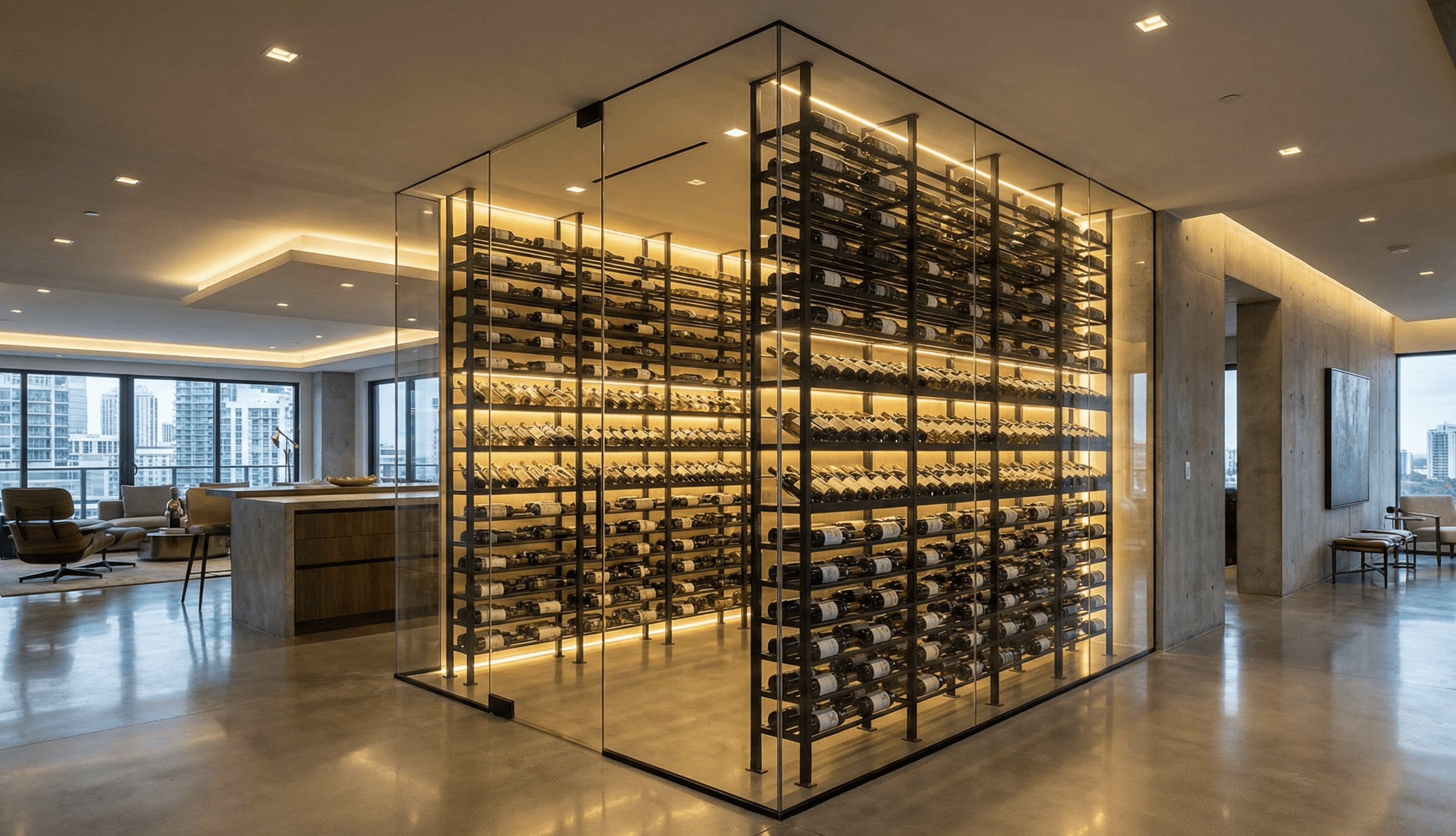
A climate-controlled wall of wine that turns a kitchen, dining room or entry into a gallery, without giving up a room to a cellar.
Best for
Kitchens, dining rooms, living rooms and entries
Signature materials
Insulated glass, black steel, white oak, aluminum
Typical capacity
150 to 600+ bottles
Pairs with
Open-plan living, wet bars and casitas
What defines it
The Five Elements of a Wine Wall


Why Homeowners Choose a Wine Wall
No spare room needed
A wine wall needs a run of wall, not a room, which makes it the natural choice for remodels and homes where every room is spoken for.
The collection in daily life
Bottles sit where you cook, dine and entertain, instead of behind a door you rarely open.
Architecture, not furniture
Built into the wall and lit like a gallery, it reads as part of the house rather than something added to it.
Every bottle within reach
Display rows put the labels you want to show at eye level, and nothing is more than a step away.
Wine Wall Design Ideas

Wine Wall Materials: Glass, Frame and Racking

Steel-framed glass
Slim black steel frames that carry tall insulated panels and doors. The most common choice for a modern or transitional wine wall.

Frameless glass
Clean glass with minimal hardware, for the most open view of the collection.

White oak racking
Tight, linear grain that suits modern and transitional rooms and pairs well with black metal.

Cables & floating rods
Tensioned cables or rods that take the rack almost out of sight, a favorite behind glass.
Where a Wine Wall Works

532 bottles in Austin
A full-length feature wall that turns the living room into a fine-dining style display.
170 bottles in Round Rock
An unused niche turned into a display behind 11-foot steel-framed glass doors.

150–600 bottles
A long run of glass beside the island or table, lit at night as the room's backdrop.

150–600 bottles
A double-height feature that greets guests, with floating racking against a backlit panel.
Engineered to Hold 55°F in a Wall
A wine wall has the same job as a walk-in cellar with far less depth to do it in, so the glass, insulation and cooling are designed together.

Insulation & vapor barrier
The walls, ceiling and floor around the glass still need insulation and a sealed vapor barrier, or condensation and heat get in.

Cooling sized for glass
Glass is the biggest heat load in a wine wall, so the unit is sized for it and holds 55°F at 50–70% humidity.

Airtight doors
Insulated, gasketed doors that close tight, so a wall of glass doesn't become a wall of leaks.

Low-heat lighting
LED lighting that shows the labels without warming the bottles.

Structure for the weight
A full 750 ml bottle weighs about three pounds, so blocking and anchoring are planned before the wall is closed.
Homes That Suit a Wine Wall
Open-plan kitchens & dining
Remodels with no spare room
Casitas & pool houses
Entries & stair halls
Modern & transitional homes
Collectors who entertain
We design and build wine walls in Austin, Dallas–Fort Worth, Houston and San Antonio, and design them nationwide through our Virtual Design Studio. Our custom projects start around $50,000 and average about $80,000, depending on length, glass, racking and cooling.
Compare Neighbouring Styles

Wine Wall FAQs
How much does a wine wall cost?
Our custom projects start around $50,000 and average about $80,000. A wine wall's cost depends mostly on its length, the glass and framing, the racking and the cooling system it needs.
Does a wine wall need a cooling system?
Yes, if you want to store wine long term. Behind sealed, insulated glass, a properly sized cooling unit holds the wall at 55°F and 50–70% humidity. Without it, a wine wall is a display, not a cellar.
Where does the cooling equipment go?
Usually out of sight. Ducted and split systems put the noisy, heat-producing parts in an attic, mechanical room or outside. At our Round Rock project the system sits in the attic, where it's quiet and easy to service.
Can a wine wall hold magnums and large bottles?
Yes, when it's planned in. We size rows for magnums and large formats from the start and check for wider Burgundy and Champagne bottles.
What's the difference between a wine wall and a glass wine cellar?
A glass wine cellar is a room you walk into. A wine wall is built into the depth of a wall, so you reach in through doors instead. It takes far less space and suits remodels and open-plan homes.
Do you build wine walls outside Texas?
We design and build in Austin, Dallas–Fort Worth, Houston and San Antonio. Elsewhere, our Virtual Design Studio designs the wall and we ship the materials and Limited Edition Wine Cellar Kits nationwide.
Design a Wine Wall for the Way You Live
Send us a photo of the wall and a rough bottle count. We'll come back with a design concept in five business days.

Email us at
Give us a call
Serving Austin, Dallas–Fort Worth, Houston & San Antonio
REQUEST A CONSULTATION
Start with a phone consultation
Share a few details and our design team will call you within 24 hours.
Request a Consultation
Tell us how to reach you.
