
By Andrew Roberts, Founder
·
QUICK ANSWER
KEY TAKEAWAYS
On a shallow wine wall, the back panel decides whether the lighting looks finished or cheap.
Painted drywall saves cost, but with only inches of depth any fixture lands as a hotspot with dark gaps.
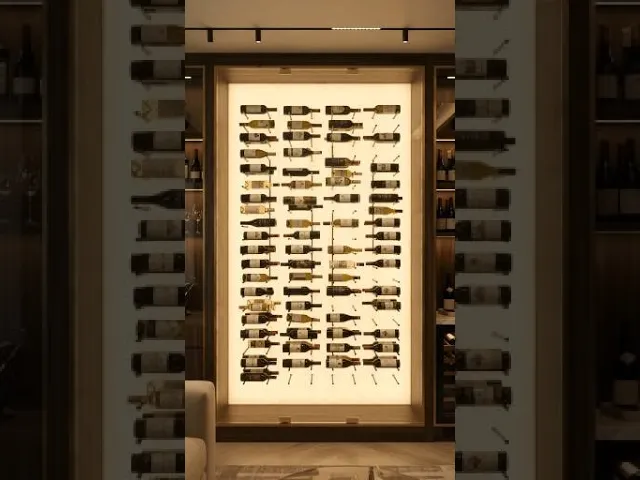
A translucent acrylic back-panel lit from behind with pure white LED turns the whole back into one even glow.
The acrylic diffuses every point source into a continuous sheet before the light reaches your eye.
LED is used because heat and UV damage wine, so the wine wall glows without warming the bottles.
The Full Breakdown

A backlit wine wall is one of the most striking ways to show a collection, and also one of the easiest to get wrong. The bottles, the racking and the glass can all be right, and the wall can still look flat if the light behind it is uneven. On a shallow display wine wall, that comes down to one surface most people never see: the back panel.
Why the back panel matters on a shallow wine wall
A display wine wall usually sits in a cavity only a few inches deep. That’s what makes it fit in a dining room, a hallway or a living room wall instead of needing a walk-in room. It also means the light source sits very close to the surface it’s lighting. In a deep room, light has distance to spread out and soften. In a shallow wine wall it doesn’t, so whatever is behind the bottles is lit almost point-blank.
What goes wrong with painted drywall
The default is painted drywall behind the bottles. It’s inexpensive and quick, and in a deep space it can work. In a shallow wine wall, any fixture pointed at flat drywall lands as a hard, bright hotspot, with dark gaps between each pool of light. Bottles in front of a hotspot glare, and bottles in the gaps fall into shadow. Instead of one glowing display, you see a row of lights on a wall, and the effect you paid for is gone.
How a backlit wine wall uses an acrylic back-panel
Our approach is to install translucent acrylic panels across the back of the wine wall and flood the cavity behind them with pure white LED. The bottles mount in front of the acrylic, often on slim metal pegs so they appear to float. From the room you never see a single light source, only a lit surface behind the bottles. It’s a small change in the build, and it changes how the whole wine wall reads from across the room.
How acrylic diffuses LED into one even sheet
The acrylic does the real work. Each LED is a point source, a small bright dot. As that light passes through the translucent acrylic it scatters, and the scattered light from every LED overlaps inside the panel. By the time it leaves the front face, it has become one continuous, even sheet of light. Your eye sees a uniform glow edge to edge: no hotspots, no shadows, just even light behind every bottle.
Why we light a wine wall with LED
Heat and UV are what damage wine. A wine cellar or wine wall is built to hold a steady 55°F, and a light source that runs warm works against the cooling every hour it’s on. Low-heat LED lighting is one of the layers we specify on every build for that reason. Behind an acrylic back-panel, LED gives the glow without warming the bottles. For more on how a wine wall holds temperature behind glass, see our video on the temperature-controlled wine wall.
Designing the bottles in front of the glow
The back-panel works best when the bottles are set up to be seen. Label-forward racking turns each bottle into part of the display, and the backlight frames every label. Our video on label-forward bottle orientation explains why we store bottles that way. If the wine wall sits behind glass, the glass system matters too; compare frameless vs steel-framed glass.
Where a backlit wine wall works best
A backlit wine wall suits rooms where people gather and look: a dining room, a living room wall, a wet bar or an entry. In a dining room wine wall, the glow becomes the backdrop to every dinner. When you’re ready to plan one, our custom wine cellar design process covers the lighting, racking and glass together, and the Custom Wine Cellar Buyers Guide walks through budget and timing.
What is the best lighting for a backlit wine wall?
Pure white LED behind a translucent acrylic back-panel. The acrylic diffuses each LED into one even sheet of light, so the whole backlit wine wall glows with no hotspots or shadows, and LED keeps heat and UV away from the wine.
Why does my wine wall lighting have hotspots?
Usually because the fixtures are aimed at flat painted drywall in a shallow cavity. With only a few inches of depth, light has nowhere to spread, so each fixture lands as a bright spot with dark gaps between. A diffusing back-panel solves it.
Does LED lighting damage wine?
LED is the right choice for wine because it runs cool. Heat and UV are what damage wine, and a wine cellar or wine wall should hold a steady 55°F. Low-heat LED lighting gives the glow without warming the bottles.
Can a shallow wine wall be backlit?
Yes. A shallow display wine wall is where a backlit acrylic panel matters most, because there's no depth for light to blend on its own. The acrylic does the blending, so even a few inches of depth can glow evenly from edge to edge.
Q: How do you get a backlit wine wall to glow evenly?
On a shallow wine wall, the back panel is where most wine cellars fail.
On a shallow display wine wall, builders default to painted drywall behind the bottles. Although this is great to save costs, it’s an aesthetic choice that can make a huge difference. With only a few inches of depth, there’s nowhere for light to travel and blend, so any fixture you point at flat drywall lands as a hard hotspot with dark gaps between. It kills the whole effect.
Here’s what we do instead. We install translucent acrylic panels across the back, then flood the cavity behind them with pure white LED. The acrylic does the real work: it diffuses the light, scattering every point source into one continuous, even sheet before it ever reaches your eye. Mount the bottles in front of that, and the entire wine wall glows seamlessly. No hotspots, no shadows, just even, liquid light.
One detail collectors don’t think about: we use LED because heat and UV are what damage wine. The glow stays gorgeous without ever warming the bottles. It’s a small detail buried behind the panel, and it’s the difference between a wine rack and the pinnacle of modern luxury.


We design backlit wine walls with diffused LED and translucent acrylic, so every bottle glows evenly and the wine stays protected.
