
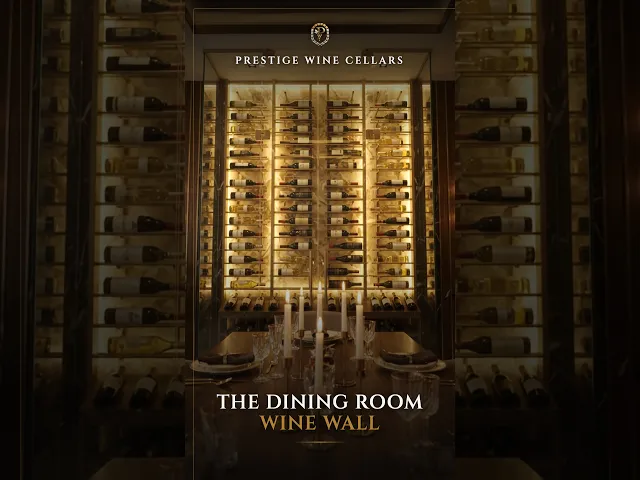
Why Put a Wine Wall in the Dining Room?
The dining room's feature wall is the one everyone at the table already faces, so a floor-to-ceiling frameless glass wine wall there frames every meal. With label-forward racking, LED backlighting and silent climate control holding 55°F, it's a real wine cellar and the first thing guests see. That makes it the highest-impact place for a collection.
Transcript
Q: Why put a wine wall in the dining room? The best seat in a luxury home is the one facing the wine wall. A dining room wine wall turns dinner into theater.
As a wine cellar expert, here’s the move. We take the feature wall of the dining room, the one everyone at the table already looks at, and we build a floor-to-ceiling frameless glass wine wall right into it. Label-forward racking, so every bottle reads like the spine in a library. LED backlighting, so the whole wall glows. And it’s fully climate-controlled and silent, holding a steady 55 degrees behind the glass, so it’s a real wine cellar, not just a display.
Here’s why this one spot beats every other location in the house. It frames the table. It’s the first thing guests see when they walk in, and the last thing they remember when they leave. It makes the whole room feel like a private restaurant built around your collection.
Of every place you could put serious wine in a luxury home, the dining room wine wall is the single highest-impact choice. It’s the one that changes how the entire room feels. Where would yours go, and who gets the seat facing it?
The Full Breakdown
Choosing the right wall. Most dining rooms already have a natural focal wall: the long wall opposite the entry, the wall behind the head of the table, or the one a chandelier is centered on. That’s where a wine wall belongs. Before design starts we check what’s inside that wall (plumbing, HVAC returns, structural posts) and where a cooling line and power can run, because a wine wall needs a little depth behind the glass for racking, insulation and airflow. In new construction that’s easy to plan at framing. In a remodel it usually means building out a shallow wall in front of the existing one.
Why label-forward racking matters at the table. Bottles stored cork-forward show a grid of capsules. Label-forward racking turns each bottle sideways so the label faces the room, which is what makes the wall read like a curated library instead of storage. It also makes service easier: the host can find a bottle from across the room and pull it without disturbing its neighbors.
Lighting and sound at dinner. A dining room is lived in at night, so lighting is part of the design, not an afterthought. LED backlighting behind the bottles gives the wall an even glow that can be dimmed to match the rest of the room’s lighting. The cooling equipment is typically placed away from the dining room, with only a quiet supply and return at the wine wall, so dinner conversation doesn’t compete with a compressor.
A real wine cellar, not a display. Glass, light and racking make the wall beautiful; the climate envelope behind the glass is what protects the wine. Insulated glass, a sealed and insulated cavity, and a cooling unit sized to the wall’s real heat load let it hold a steady 55°F in a warm, busy room, so the collection on display is also aging properly.
The Best Seat in the House, Designed
We plan the wall, glass, racking, lighting and silent cooling together, so your dining room wine wall frames every meal and protects every bottle.