
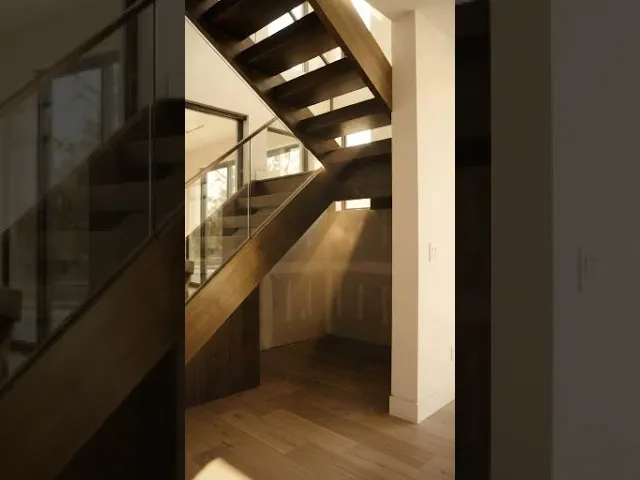
What Are the Best Under-Stairs Wine Cellar Ideas?
Match the design to the staircase. A straight run suits floor-to-ceiling frameless glass with label-forward racking. Curved and spiral stairs take bent glass. A tight hallway takes a shallow double-deep wall under 16 inches deep. A deep corner takes angled display racking, and a small nook becomes a jewel-box wine cellar. Every style needs a vapor barrier, insulation and correctly sized cooling.
Transcript
Q: What are the best under-stairs wine cellar ideas?
Five ways to turn the dead space under your stairs into a wine cellar. The short answer: there’s no wrong staircase. Let me walk you through them.
Have a straight run? We go floor-to-ceiling frameless glass with label-forward racking, so the whole staircase becomes a glowing display.
Curved or spiral stairs? We bend the glass to follow the curve. Now, it’s way harder to engineer and drastically more expensive, but it’s hands down the most jaw-dropping under-stairs wine cellar there is.
Stuck with a tight hallway? A shallow, double-deep wall reads twice as big as it is, holding far more bottles than they expect from less than 16 inches of depth.
Got an awkward, deep corner that’s always wasted? We use angled display racking that turns that dead corner into the hero of the room.
And even a powder-room-size nook becomes a jewel box: a tiny, perfectly climate-controlled under-stairs wine cellar that stops every guest.
The thing they all share is real engineering underneath: a sealed vapor barrier, insulation, and a cooling unit sized to the exact cubic volume of conditioned space. The only bad under-stairs wine cellar is the empty space you’re staring at right now. Save this for the staircase in your house.
The Full Breakdown
Start with the staircase you actually have. Before anyone talks about racking or glass, we look at how the stair is built: an open or closed stringer, a straight or turning run, how much headroom there is under the landing, and what’s on the other side of each wall. Those details decide which of the five layouts fits. A straight run gives a long, even face for glass. A spiral gives a curved one. A hallway gives width but very little depth. A corner gives depth but an awkward footprint. A nook gives one small, enclosed room. Most homes fall clearly into one of these, so the design conversation can start from what the house already offers.
Curved glass is a different project, not just a different shape. Bending the glass to follow a curved or spiral staircase means custom-formed panels, tighter tolerances at every joint, and a lot more site measuring before anything is made. That’s why it costs more and takes longer than a straight run. It’s also why it’s the version people stop and photograph. If the staircase is already the architectural focus of the house, curved glass makes the wine cellar part of it rather than something tucked underneath.
Small and shallow spaces can still hold a real collection. In a hallway, a double-deep wall stores a second row of bottles behind the label-forward front row. Seen from the hallway, the collection looks about twice as deep, and it still fits in less than 16 inches. In a corner, angled display racking fans the bottles out toward the room, so the deepest part of the corner becomes the most visible part. And in a powder-room-size nook, the small volume is an advantage: it’s quick to cool and easy to keep stable.
The engineering is identical in all five. Whatever the layout, the room has to work as a wine cellar. That means a continuous sealed vapor barrier, insulation in every wall and the stair underside, and a cooling unit sized to the room’s actual cubic volume, not a guess. A small under-stairs wine cellar with an oversized unit cycles on and off. One with an undersized unit never catches up. Sizing it to the conditioned space is what holds the temperature steady.
Find the Right Idea for Your Staircase
We measure your stairs and headroom, then design the glass, racking and cooling that fit the space you already have.