
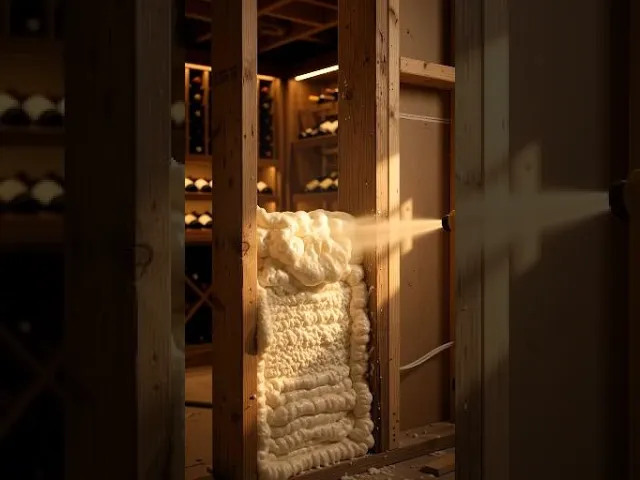
Why Do You Use Closed-Cell Spray Foam Insulation in a Wine Cellar?
Because fiberglass is open and lets warm, humid air into the wall, where it cools below its dew point and condenses — soaking the insulation and growing mold. Closed-cell spray foam does two jobs in one layer: it insulates at roughly R-6 to R-7 per inch and acts as a vapor barrier, so moisture never reaches the wall cavity.
Transcript
Q: Why do you use closed-cell spray foam insulation instead of fiberglass in a wine cellar?
This one difference could cost you $50,000 on a wine cellar. Fiberglass is perfect for a living room. It’s a death sentence for a wine cellar, and here’s why. Fiberglass is open and fluffy, so air and moisture pass right through it. Now picture the wall: inside, 55-degree cellar air; outside, a 100-degree Texas afternoon pressing in. Somewhere in that cavity, the warm, humid air cools below its dew point, and water condenses right inside the wall. The fiberglass turns into a wet sponge — and that’s not even the worst part. A wet wall is a moldy wall, and mold means tearing the whole room back to the studs and starting over. So we don’t use it. We use closed-cell spray foam, which does two jobs in one layer. It’s a top-tier thermal insulator at roughly R-6 to R-7 per inch, and it’s a vapor barrier — it stops moisture from ever migrating into the wall. One layer, both problems solved. That’s the choice that protects the framing, the wine, and your budget. One material decision, 50 grand on the line. Share this with anyone about to let a general contractor just use fiberglass.
The Full Breakdown
A wine cellar runs backwards from the rest of your house. Your living room is cooled in summer to the low 70s, so its walls see only a modest temperature difference. A wine cellar is held near 55°F all year. In a Texas summer that means a 40- to 45-degree difference across a few inches of wall, and the warm, humid side is the outside. Water vapor always moves from warm and humid toward cool and dry, so it is constantly pushing into the wall cavity toward the cold cellar side.
Fiberglass insulates, but it doesn’t seal. Batts slow heat, but air and vapor move through them freely. Once that humid air reaches a surface inside the cavity colder than its dew point, it turns to liquid water. Wet fiberglass loses most of its insulating value, the cooling unit has to run harder, and the framing and drywall stay damp. That is how mold starts, hidden behind finished racking where nobody sees it until the smell or staining appears.
Closed-cell spray foam fixes both problems in a single layer. It expands to fill every gap around studs, outlets, and penetrations, adheres directly to the framing, and its closed cells resist the passage of water vapor. That gives the wine cellar a continuous thermal and moisture envelope, which is what lets a properly sized cooling unit hold temperature and humidity steadily for decades. It’s one of the first things we specify on every Prestige build, before a single rack goes in.
One Layer, Both Problems Solved
We seal every Prestige wine cellar with closed-cell spray foam before a single rack goes in — so the walls stay dry, the temperature holds, and the wine stays safe.